
Malaysian AI Show & Tell Recap: 14 Live Demos in Kuala Lumpur (Oct 8, 2026)
14 live demos at Malaysian AI Show & Tell in KL: AI video pipelines, Claude Code workflows, voice dictation, construction cost parsing, and health apps.
Fourteen builders took the floor at Malaysian AI’s Weekly Show & Tell in Kuala Lumpur on October 8, 2026. A clear pattern emerged across the night: builders are moving past one-shot prompts and wiring models into real production pipelines, whether that means exporting XML timelines to DaVinci Resolve, running deterministic code scratchpads over construction spreadsheets, or replacing $15/month dictation subscriptions with custom hotkeys.
Agentic Video Editing and Creator Pipelines
Four separate demos tackled video production from different angles, sharing concrete lessons on where LLMs help and where traditional rendering engines still win.
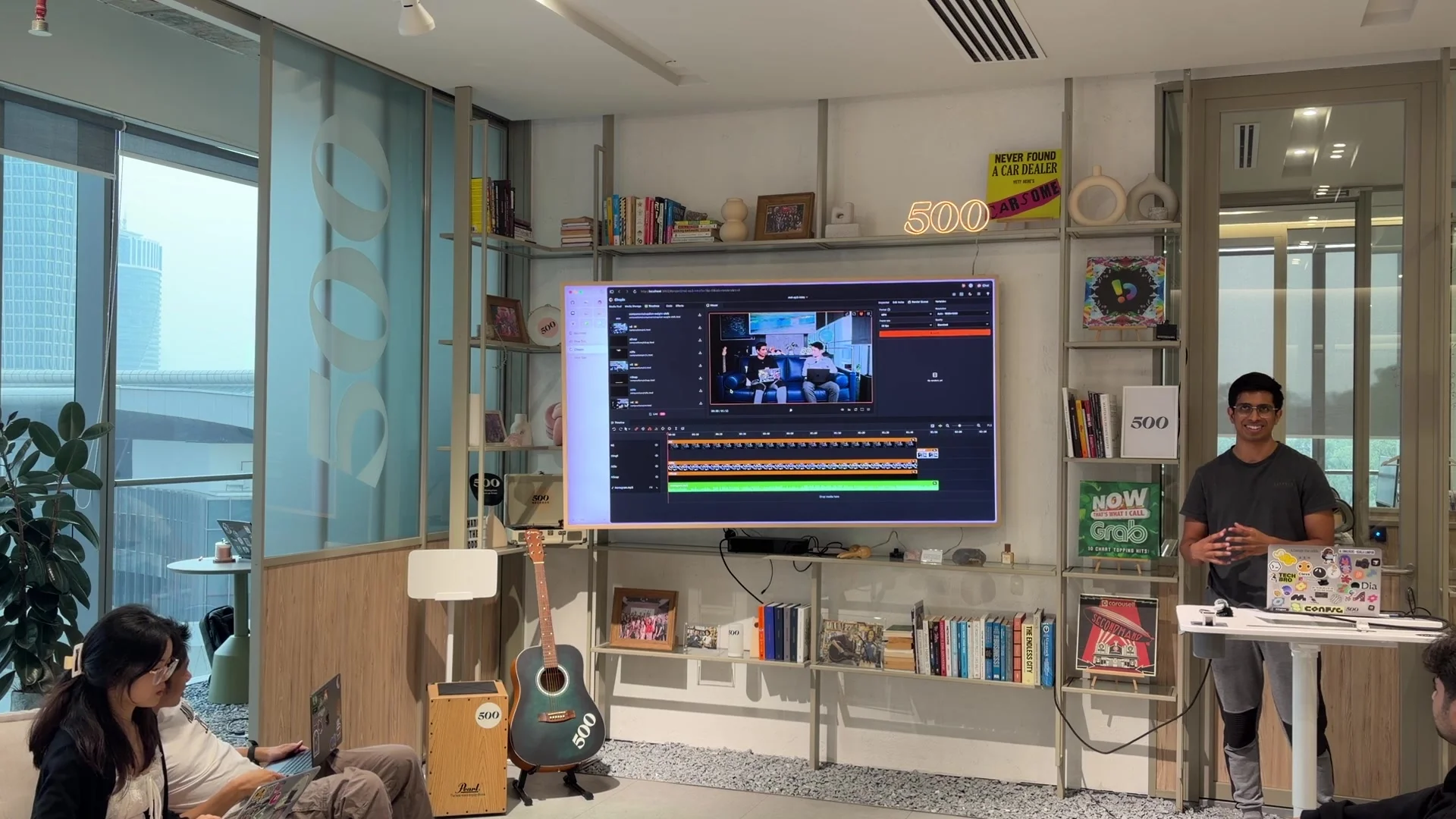
Ashvin Praveen broke down the performance wall of editing 4K S-Log camera footage with AI. Asking an LLM to render full 4K video files directly becomes painfully slow when a single fade-out tweak forces a full re-render. Instead, Ashvin prompts Claude or GPT to output standard XML timeline files for cuts and hands the final render to DaVinci Resolve. Because basic XML cannot express social-style motion graphics, he built Chopin, a browser-based fork of Hyperframes that uses HTML-style rendering. To stop the browser from choking on raw 4K files, he built a local proxy renderer with Claude that generates 360p proxies for smooth timeline scrubbing before exporting the final XML.
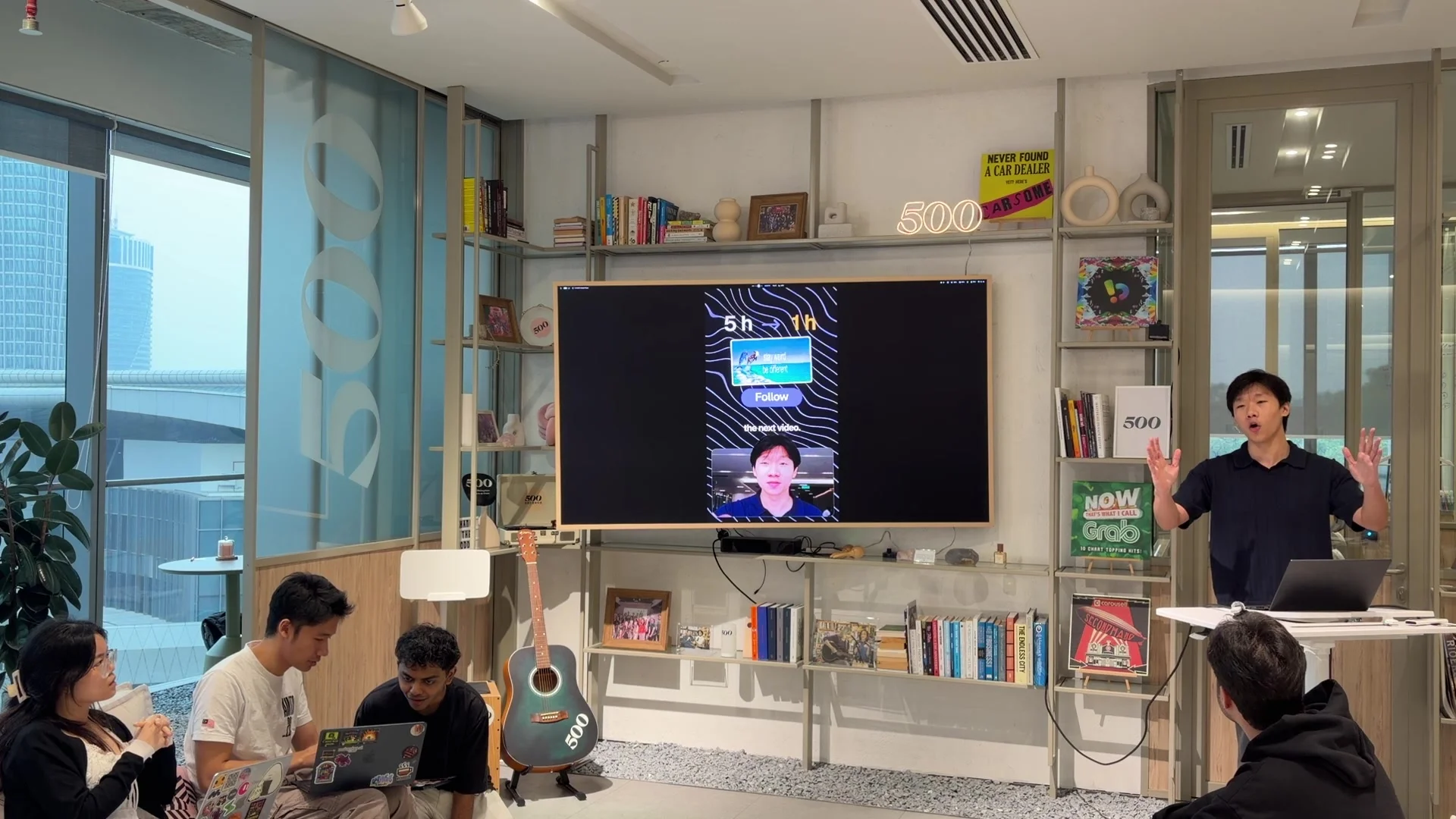
James Chu demonstrated AIOS2, an agentic video editing workflow built directly on top of Claude Code rather than as a standalone app. Built to cut editing turnaround from five hours down to one hour, AIOS2 automates motion graphics, background tracks, beat-matched cuts, vocal cleanup, relighting, and masking. Instead of slow real-time timeline scrubbing, the system outputs grids of timestamped PNG still frames (for example, marking second 24) so the creator can inspect frames and prompt Claude Code for exact fixes before final rendering. During Q&A, James noted he moved away from Remotion because previewing was too slow, switching to an open-source HTML and physics-based engine called One Take.
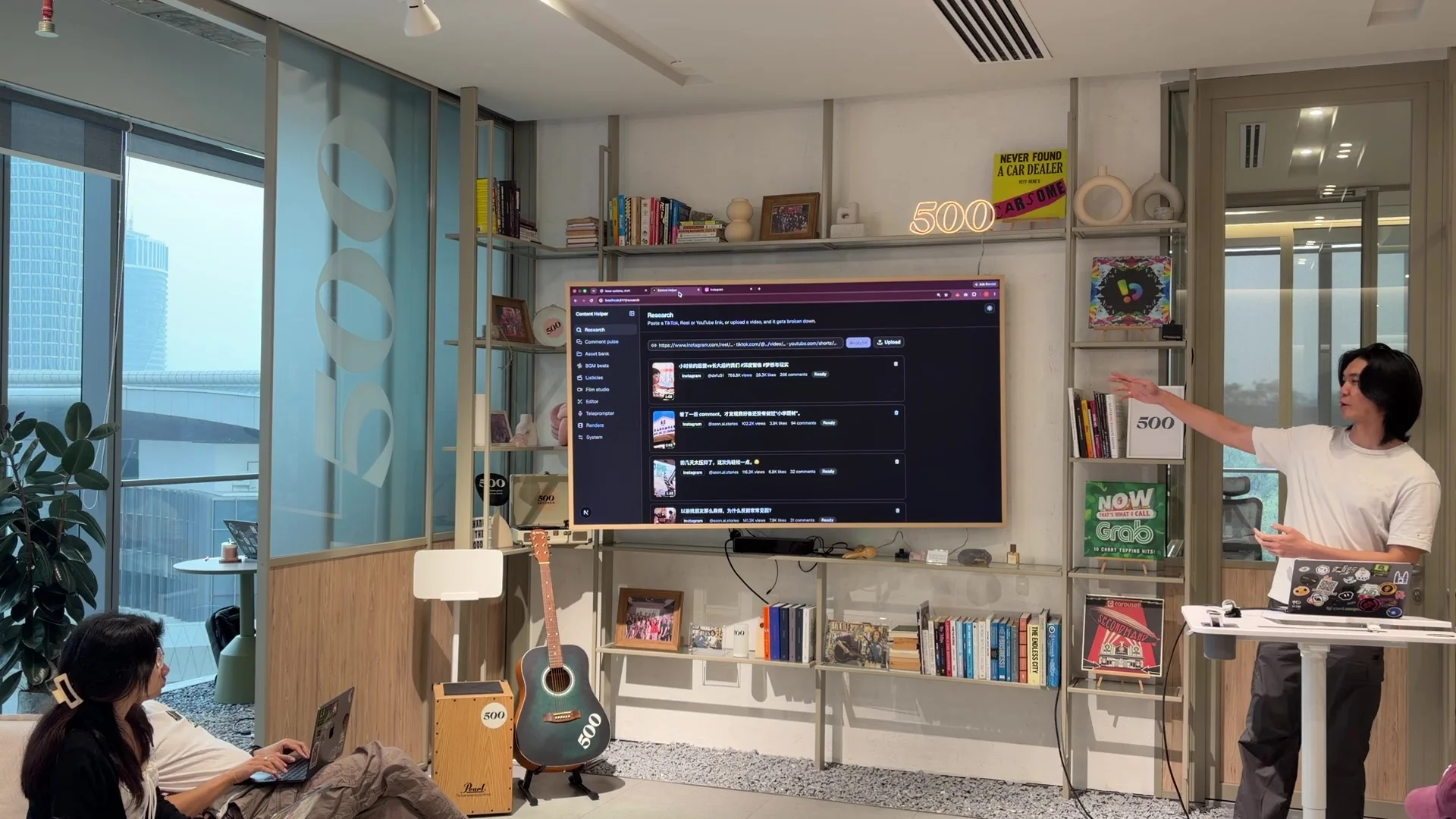
Gabriel Yong walked through an integrated short-form video suite built around fast iteration. His Research Pipeline uses Apify to pull TikTok, Instagram Reels, and YouTube videos and break them into structured shots, beats, and script lines that Claude Code can read directly. He also showed Comment Pulse for sentiment classification, a GPT real-time voice teleprompter that tracks spoken Mandarin and English without manual scrolling, a Chopline editor fork, and a Film Studio interface for swapping tracks and scene order. Gabriel shared an A/B test where four edits of the same core Reel produced wildly different reach: two crossed 100,000 views, one hit roughly 5,000, and one got under 100, driven purely by sequence order and music. He also built an Apify scraper to check competitor views every two hours, noting the cost tradeoff after burning roughly $25 in trial credits across five accounts in four days.
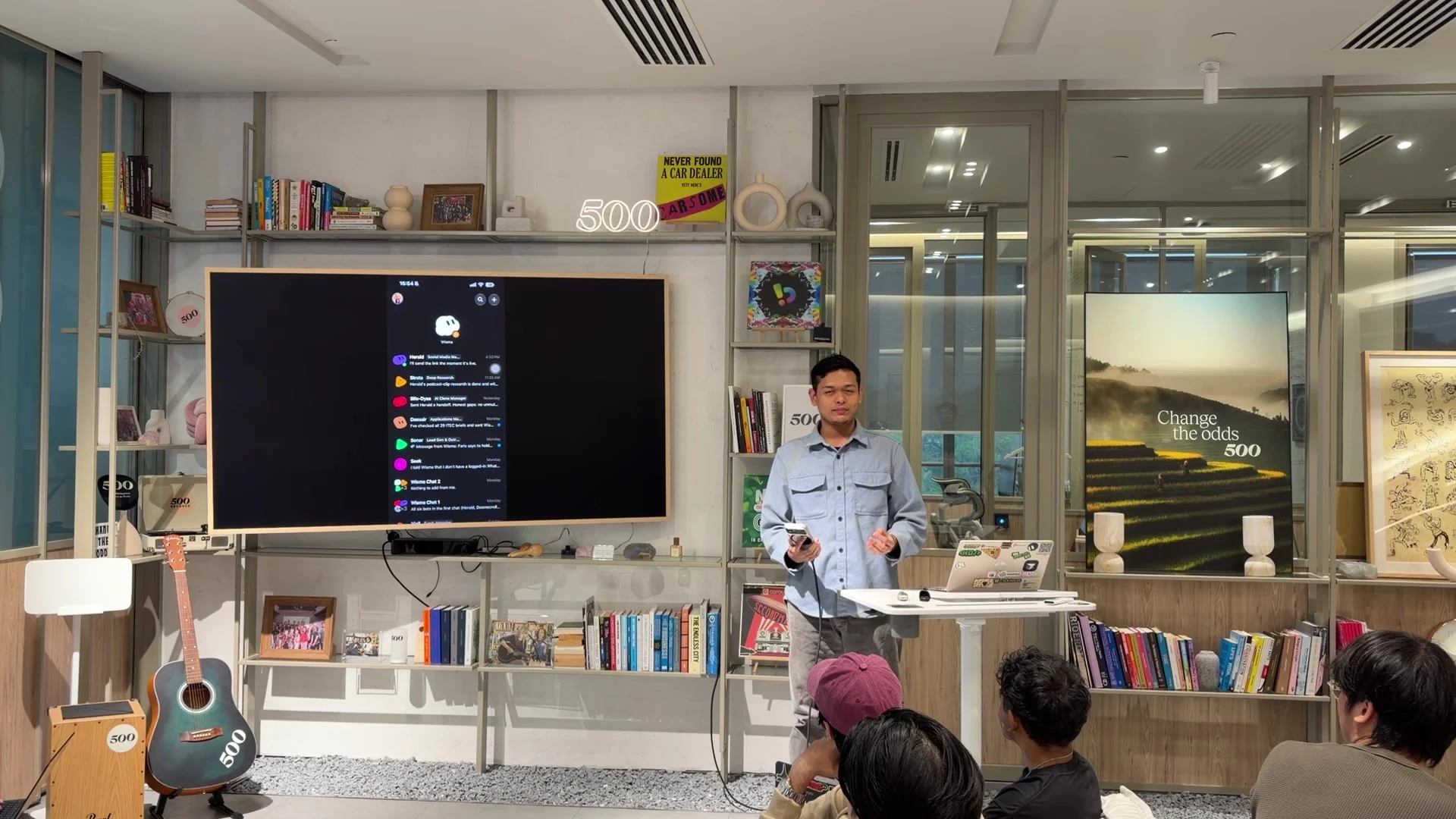
Faris Irfan presented Harold, an AI social media manager and video editor from Rizqey Labs, alongside his other agents Dossair (automated form filling) and Strata (Figma research). Using raw podcast clips recorded on iPhone 13 and iPhone 15 devices at TRX with budget microphones, Harold processed footage through Grokbot to output four aesthetic cuts simultaneously in a 2x2 grid for side-by-side comparison. Faris also demonstrated a two-agent audio repair workflow where a research agent investigates audio-engineering concepts like equalization, faders, and bass management, then guides an editing agent to strip painful high-frequency robotic static from an interview clip.
Workflow Automation and Enterprise Extraction
Several builders focused on messy operational data where accuracy, auditability, and human verification matter more than flashy chat interfaces.
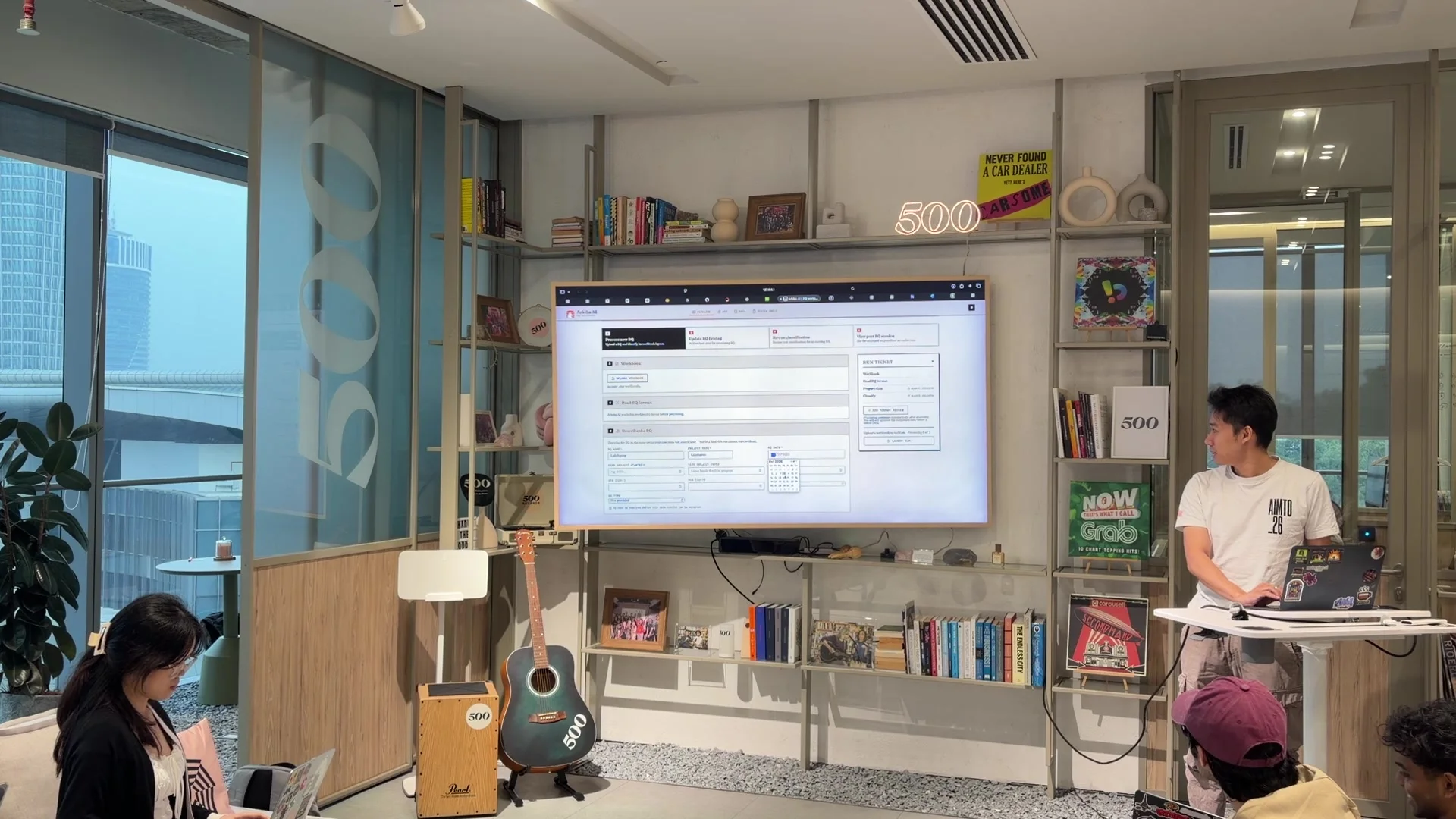
Brendan Beh presented Phoenix x BIA, an extraction and querying harness built for property developers drowning in hundreds of pages of unstandardized contractor cost sheets (with item descriptions, quantities, units, and rates in RM). Instead of building a complex RAG pipeline, Brendan found that granular data tagging paired with straightforward grep search delivered far more reliable lookups. To stop models from hallucinating arithmetic, the harness runs rule-based line-item checks and gives the agent an executable code scratchpad to compute exact totals. Asked about vibe coding during Q&A, Brendan noted that while AI wrote roughly 80 percent of the codebase, human engineering drove the system architecture and classification rules.
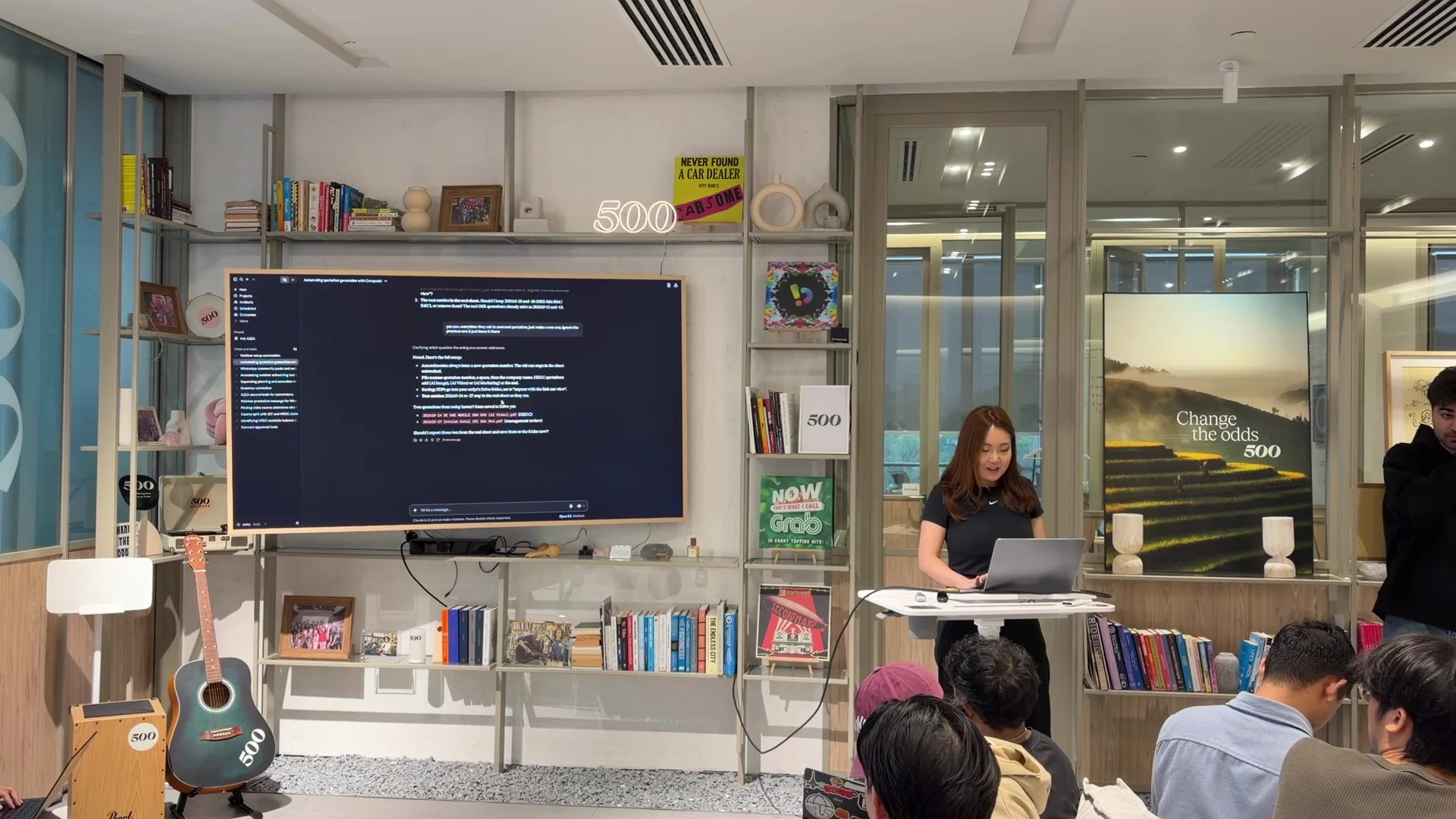
Camy Lee demonstrated practical back-office automations connecting Claude to Google Drive and Google Sheets through Composio. In her quotation workflow, pasting a customer inquiry chat into Claude parses the conversation, fills a structured quotation sheet, and exports the PDF to Google Drive. She also demonstrated table deduplication and an invoice extraction workflow that handles arbitrary, non-templated PDF layouts rather than requiring a single fixed format. When live LLM generation latency bumped into demo time limits, Camy switched cleanly to pre-recorded screencasts and cached chat threads so the room could inspect the final outputs without waiting.
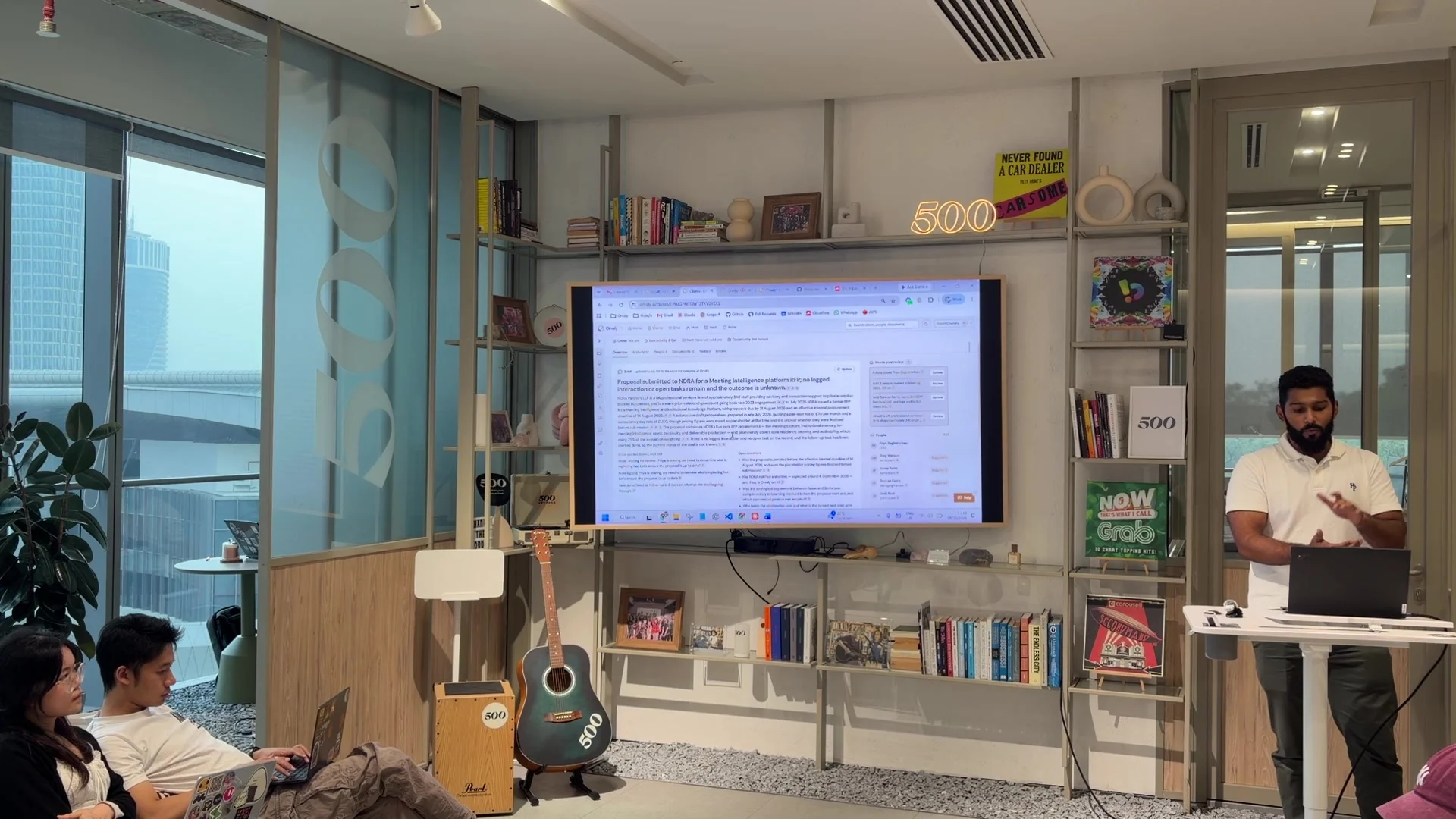
Rasan Chandra demoed Orvali, a platform that merges meeting intelligence and client management to stop context fragmentation across accounts. Orvali automatically updates client records from meetings and saved documents while tagging every fact with its exact source provenance. It synthesizes dynamic client briefs ahead of calls, surfaces talking points and topics to avoid inside a live meeting tab, and enforces a human-in-the-loop review step so users verify AI-captured notes (such as a client contact leaving a company) before writing them permanently to the record.
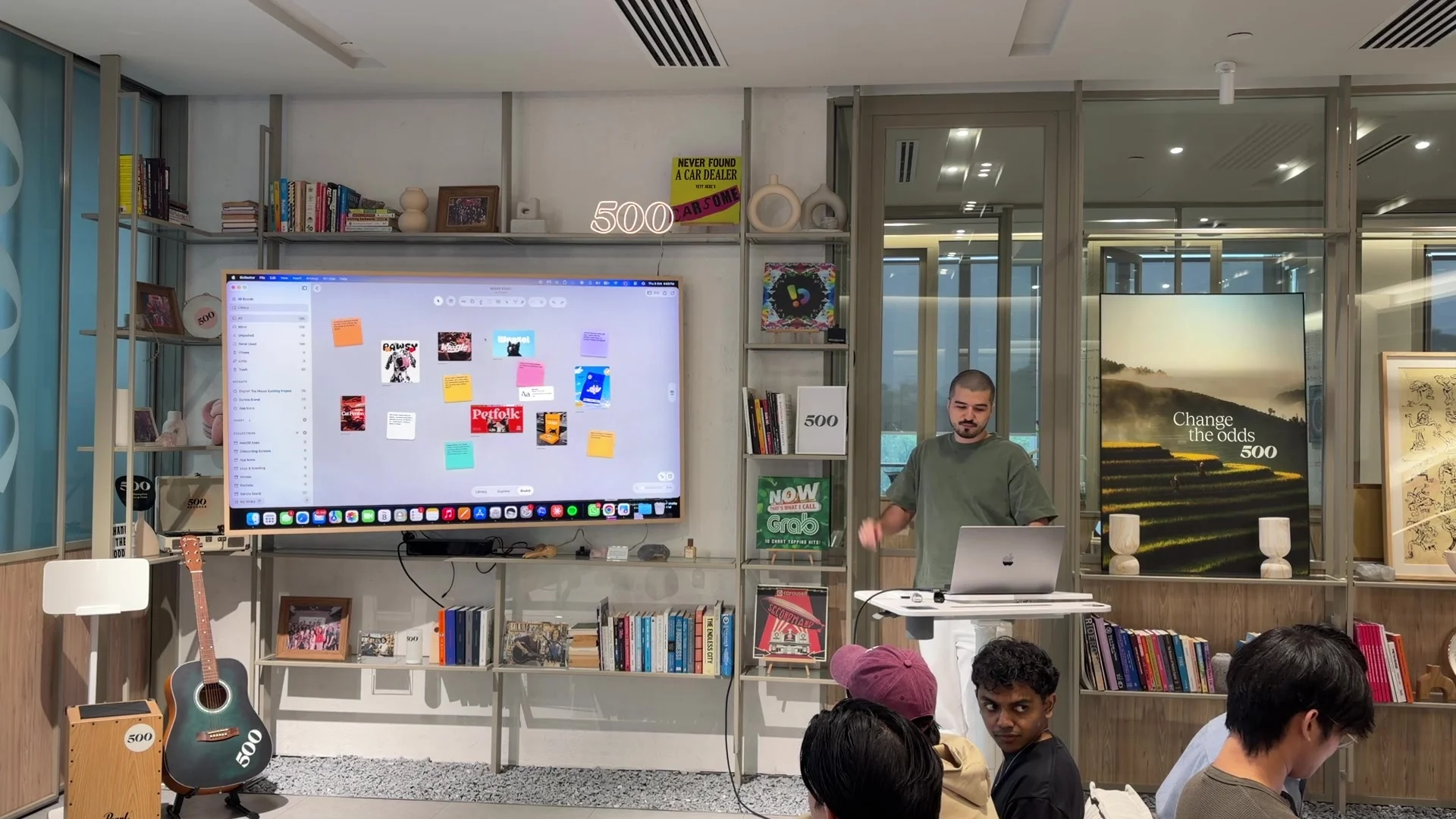
Matthieu Morisset showed an interactive AI whiteboard and mind-mapping canvas built for visual thinkers who do not want to plan websites solely through text prompts. Users arrange mood boards, Pinterest references, branding assets (demonstrated with ‘Petfolk’ Dalmatian and product imagery), and sticky notes across modular boards. The canvas supports both manual nodes and agent-generated branches, synthesizes HTML for UI elements directly from visual references, and includes a top-level handoff button that exports board context to Claude Code, Codex, or custom coding agents. To work around live agent latency, Matthieu keeps independent boards open so generation runs asynchronously while he continues working elsewhere.
Personal Tools, Voice, and Interactive Experiments
Not every build in the room was an enterprise SaaS product. Three presenters demoed personal utilities, creative experiments, and focused learning apps.
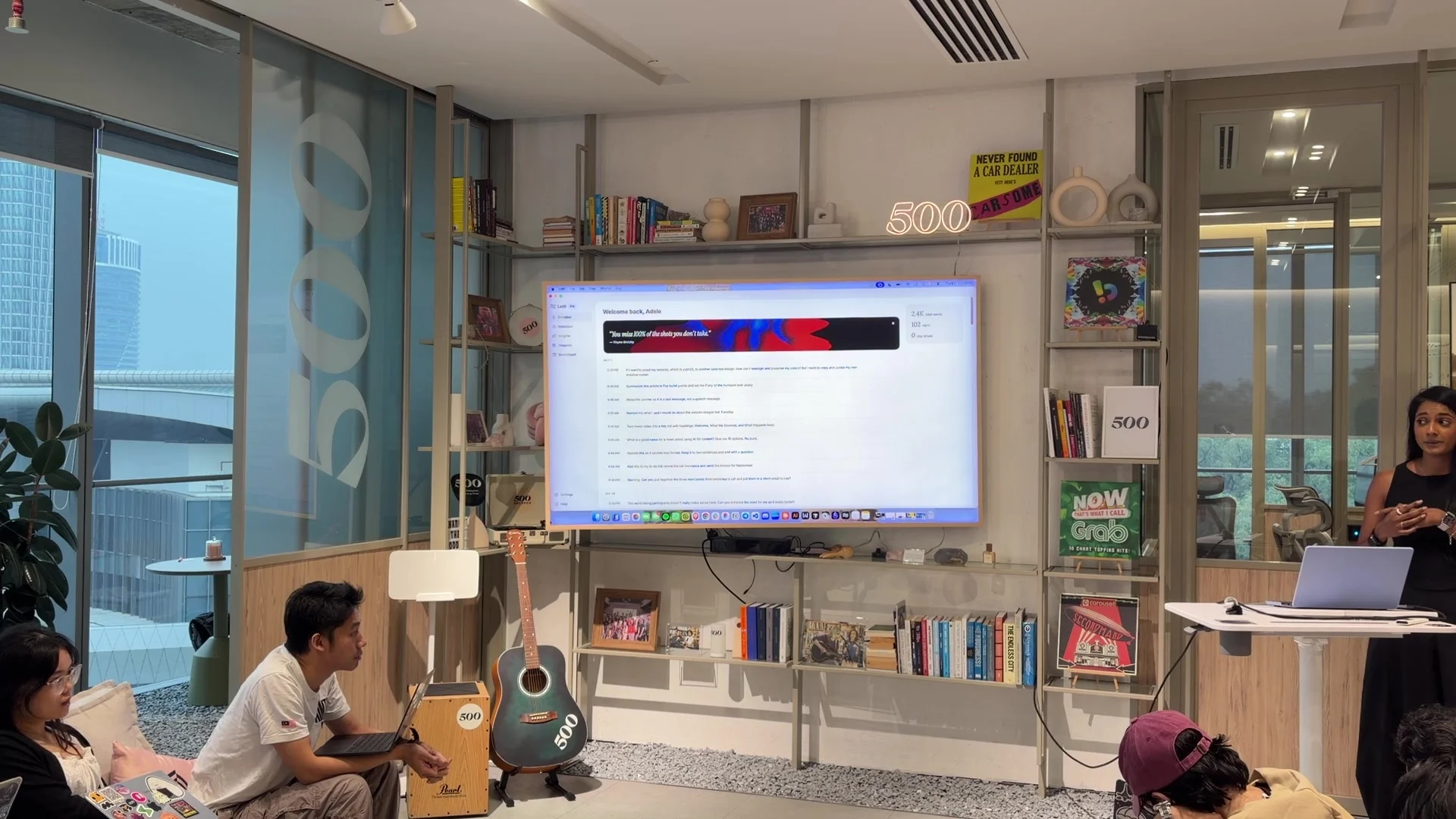
Adele built a custom desktop voice-to-text dictation and note-taking app to replace $15/month subscription tools like Wispr Flow. Triggered by an Option hotkey, her app uses a two-layer pipeline: Deepgram’s speech-to-text API (running on $200 in developer credits) paired with Claude Haiku for light grammatical cleanup, later upgraded with Deepgram’s embedded cleanup model to cut down an early 3-second latency lag. It includes an Insights dashboard, a Notes workspace, and keyword Snippets (saying ‘LinkedIn’ expands into a full URL across Claude, ChatGPT, or WhatsApp). Rather than overwriting the clipboard, the tool injects text directly into active windows via accessibility APIs.
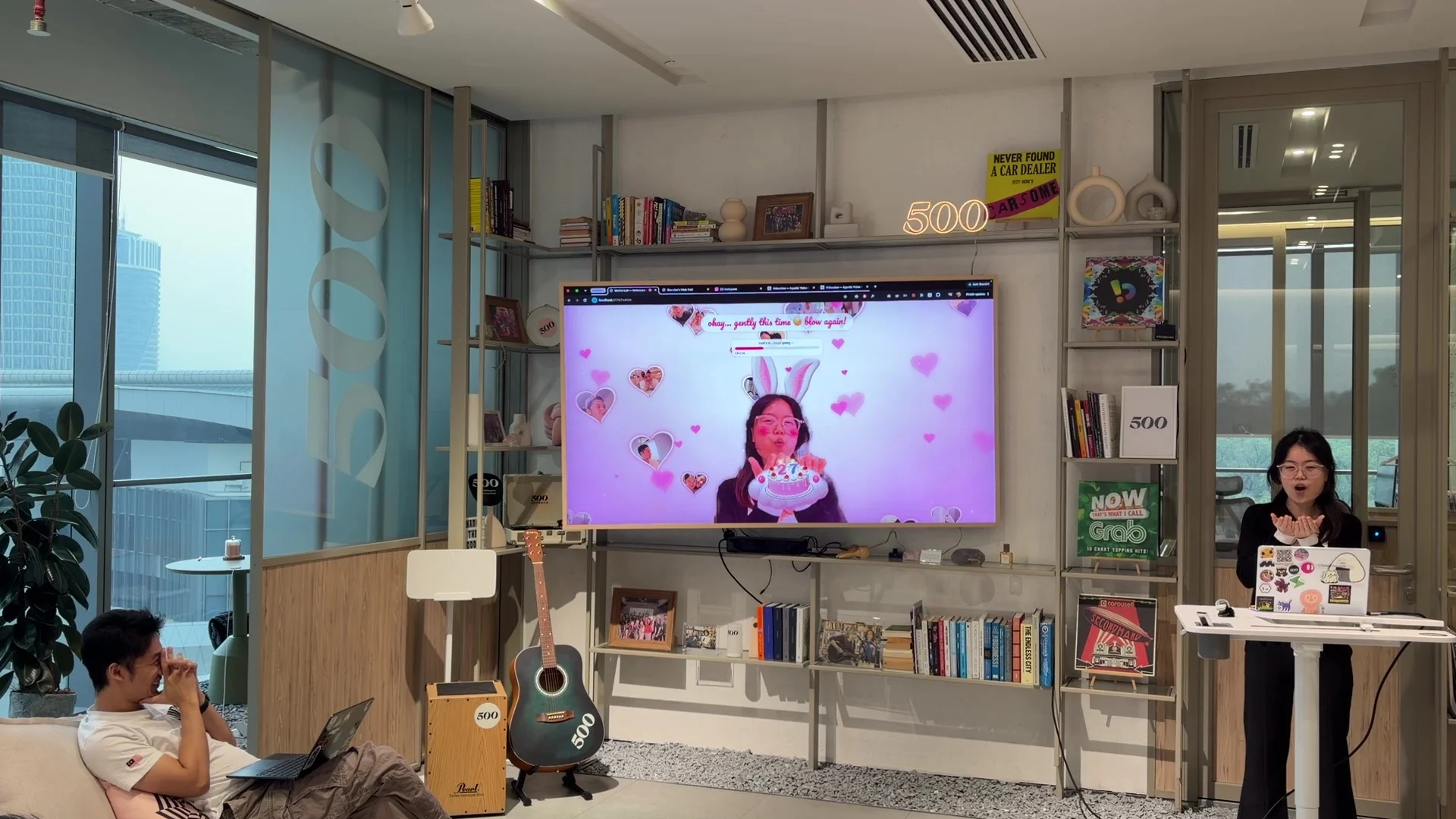
Lynnette Tee brought an interactive birthday celebration web app built for Brendan, gated by computer vision gesture detection through the laptop webcam. Holding specific hand and face poses triggers ‘MOTION GESTURE COMPLETE’ and launches bunny ear overlays, floating hearts, candle blowing, and a multimedia wish wall where friends submit photos, drawings, and transcribed voice notes. She shared a practical client-side lesson: rendering too many heavy multimedia cards at once caused noticeable browser lag and memory pressure. She also noted that feeding an Instagram reference video into Claude got her roughly 80 percent of the bunny effect before spending two hours on the wall UI, and closed with a retro TV and cassette prompt interface concept for a video startup.
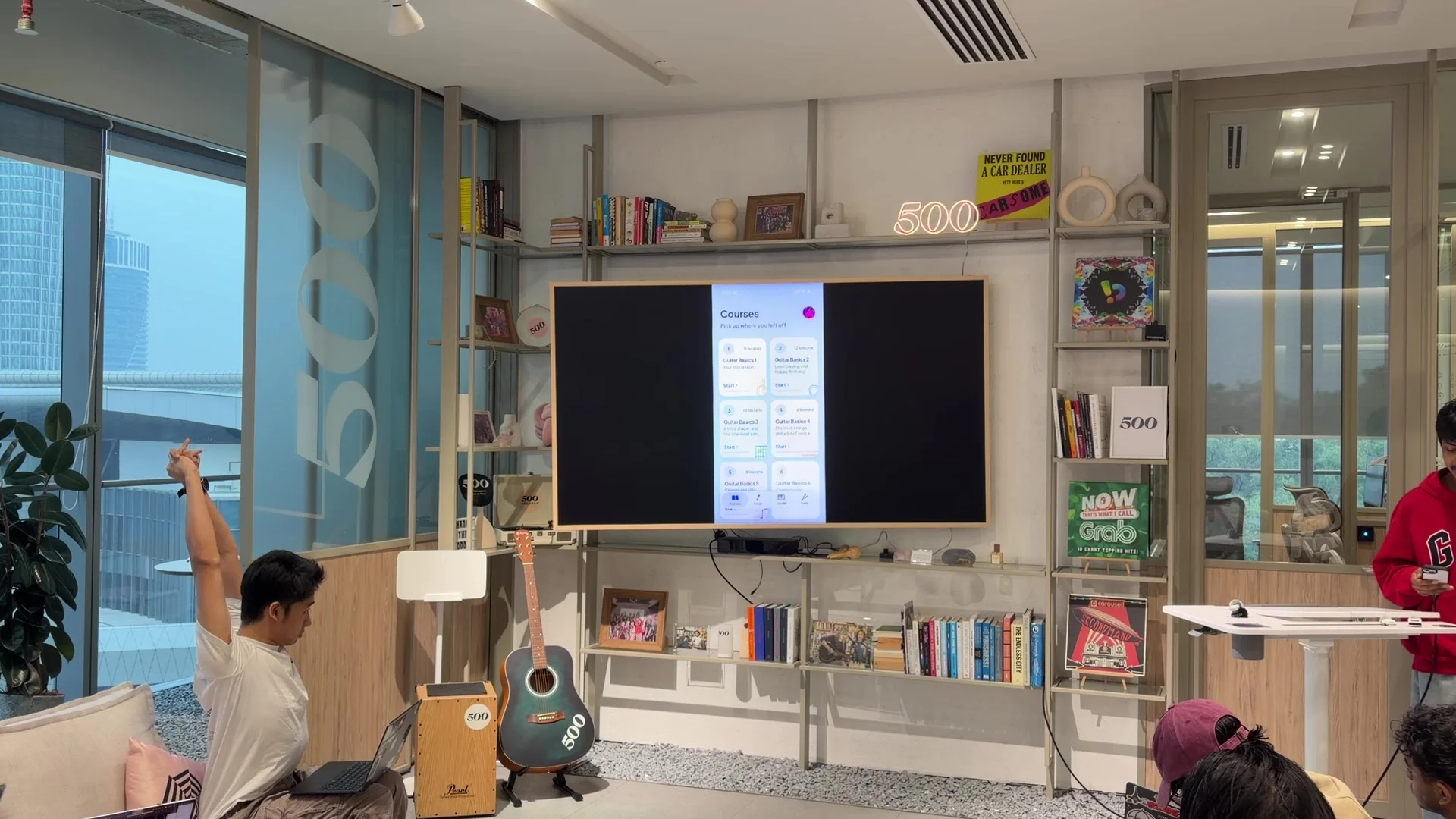
Abhinav Sanjay Madke demonstrated a beginner guitar mobile app that intentionally keeps AI out of the core user-facing lesson flow in favor of deterministic instruction. The app features structured modules like ‘Guitar Basics 1’, a chord library, a built-in microphone pitch tuner, and a Songs section that displays capo placement prompts before starting real-time scrolling chord diagrams. While Abhinav designed the initial syllabus from his own guitar knowledge, he used AI tools for visual assets, built an automated AI pipeline for course content, and is currently testing AI-powered playing accompaniment.
Vertical Platforms for Health and Events
Three founders walked through live vertical platforms tackling local health testing and event ecosystems.
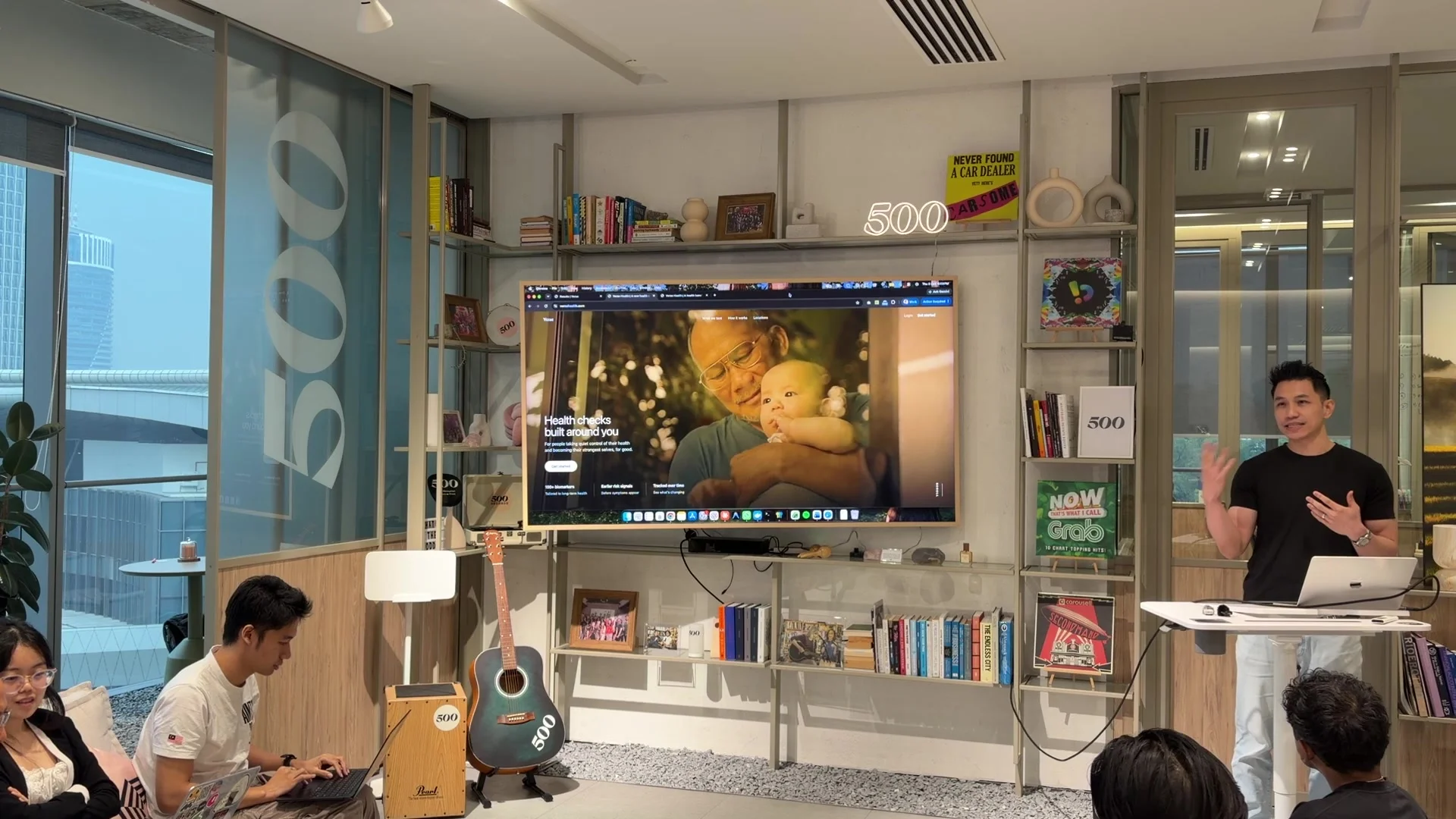
Mark Chua introduced Vere Health, a Malaysian virtual clinic offering personalized preventative blood test packages (priced around RM1,099 compared to RM3,000 elsewhere) paired with doctor consultations. On the clinical side, an internal dashboard digitizes lab biomarkers, charts historical trends, flags suboptimal markers, and helps doctors prescribe plans across nutrition, sleep, supplementation, and medication. Mark shared a sharp go-to-market takeaway: instead of chasing cold users, targeting former colleagues at Roland Berger who had corporate health benefits brought in five to six paying customers and five-figure revenue in two and a half weeks. He also confirmed during Q&A that while Vere Health administers its own test panels, patients can upload historical third-party medical records.
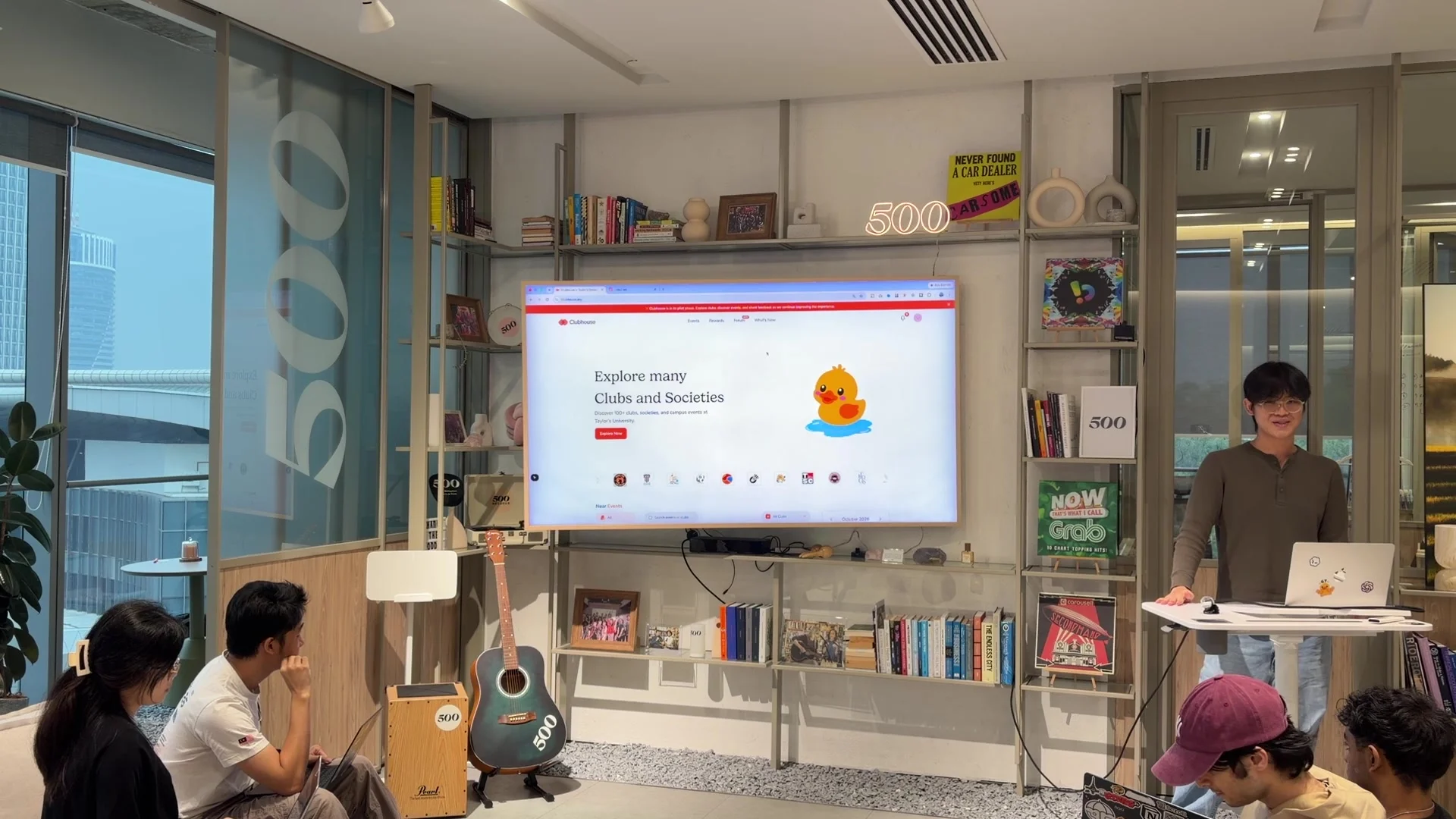
Ferdinand Natanael presented ClubPass (also shown as Clubhouse and live at clubpass.my), a centralized discovery and event management platform piloted with Taylor’s University management for registered clubs and societies. Modeled on Luma’s familiar organizer UX, it includes category filters, calendar views, registration questionnaires, QR ticketing, and campus block venue mapping. Ferdinand hand-coded the original front end two years ago before adopting Claude Sonnet 3.5, Claude, and OpenAI Codex for back-end features, and uses Groq with structured templates to auto-generate weekly Instagram event roundup posters (@clubpass_my). On notifications, he chose email over WhatsApp because Meta’s per-message business API fees make automated WhatsApp broadcasts too costly for student clubs.
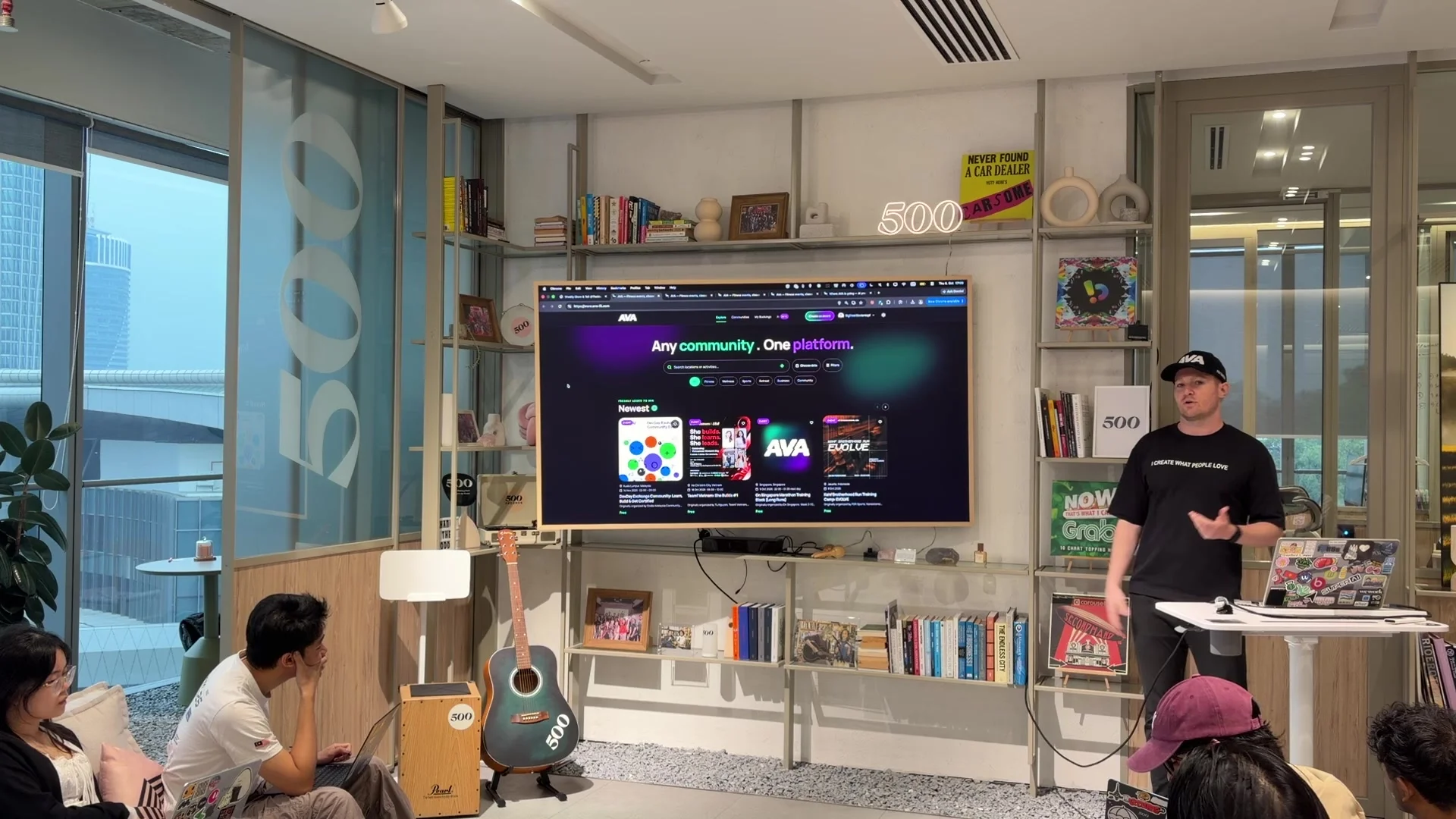
Sigfried Siedentopf closed the event-tech theme with Ava, a multi-sided event platform covering planning, discovery, and monetization. Ava uses automated AI agents to aggregate roughly 1,000 active daily events from Luma, Ticketmelon Thailand, Eventbrite, Eventpop, and Facebook into a Market Insights dashboard. Organizers can spin up event pages, book venues, caterers, and photographers with local payments, and use an AI Canvas to coordinate budgets. Sigfried argued that proprietary operational and pricing data gives vertical platforms an edge over generic foundation models like ChatGPT or Claude, which lack real-time vendor pricing. Ava currently runs as an installable web app via Chrome.
Practical Lessons from the Room
- Decouple AI decisions from heavy execution: Whether exporting XML timelines to DaVinci Resolve (Ashvin) or running deterministic code scratchpads for construction math (Brendan), let LLMs handle structure and decisions while specialized engines handle rendering and arithmetic.
- Simpler retrieval often beats complex RAG: Granular domain tagging paired with grep search outperformed heavy retrieval pipelines for messy contractor documents.
- Design around real-world latency: Keep cached outputs or pre-recorded fallbacks for live demos (Camy), run multi-board async generation (Matthieu), or inspect timestamped PNG grids instead of waiting on full video renders (James).
- Watch API and channel unit economics: High-frequency scraping burns credits fast (Gabriel), per-message WhatsApp API fees price out student clubs (Ferdinand), and combining developer credits with lightweight models like Claude Haiku can replace recurring SaaS subscriptions (Adele).
Join the Next Show & Tell
Building something with AI in Malaysia and want honest feedback from other builders? Join us at the next Weekly Show & Tell @TheMalaysian.ai Residency on Thu, 26 Nov 2026 at 12:00 pm MYT in Kuala Lumpur, Malaysia.
Featured speakers & demos
14 builders demoed during this session. Browse full talk notes and Q&A in the Knowledge Base
Interactive AI Canvas and Mind-Mapping for Web Scaffolding
Matthieu built an interactive AI whiteboard and mind-mapping canvas that lets visual thinkers organize mood boards, reference images, and sticky notes before handing site scaffolds off to coding agents like Claude Code or Codex.
Automating Quotation and Document Processing with Claude
Camy demonstrated Claude workflows wired to Google Drive and Google Sheets via Composio to convert customer inquiry chats into formatted sales quotations and extract structured data from arbitrary invoice PDFs.
AI Business Agents and Harold Video-Editing Demo
Faris demoed Rizqey Labs' Harold agent generating four side-by-side podcast edits from raw TRX mobile footage and paired a research agent with an editing agent to clean severe robotic static from interview audio.
Vere Health Virtual Clinic and Preventative Blood Panels
Mark presented Vere Health, a Malaysian virtual clinic providing personalized preventative blood panels and a clinical dashboard where doctors track biomarkers, review uploaded historical records, and prescribe interventions.
ClubPass Campus Discovery and Event Management Platform
Ferdinand demonstrated ClubPass (clubpass.my), a campus club and event platform piloted at Taylor's University featuring Luma-style registration, QR ticketing, campus venue mapping, and Groq-automated Instagram roundup posters.
Ava End-to-End Event Lifecycle and Market Insights Platform
Sigfried introduced Ava, an event platform that scrapes roughly 1,000 daily global events into a Market Insights dashboard while combining venue and vendor booking with an AI planning canvas.
Custom AI Voice-to-Text Dictation and Note-Taking Tool
Adele built a personal desktop voice dictation app using Deepgram and Claude Haiku with an Option hotkey, keyword snippets, usage insights, and direct text injection via accessibility APIs.
Beginner Guitar Learning and Microphone Tuning Mobile App
Abhinav demoed a beginner guitar mobile application combining deterministic lesson modules, a built-in microphone pitch tuner, capo setup prompts, and synchronized scrolling chord charts.
Phoenix x BIA Construction Cost Extraction Harness
Brendan presented Phoenix x BIA, an extraction and querying platform for property developers that uses granular tagging, grep search, line-item validation, and a code scratchpad to verify math across inconsistent contractor cost sheets.
AIOS2 Agentic Video Editing on Claude Code
James built AIOS2 on Claude Code to automate video editing from five hours down to one hour, using timestamped PNG still-frame grids for prompt-based revisions and the HTML physics engine One Take for motion graphics.
Interactive Computer Vision Birthday App and Retro Video UI
Lynnette demoed a birthday web app using webcam gesture detection to trigger animations and a multimedia wish wall, followed by a retro television and cassette prompt interface concept.
Orvali Meeting Intelligence and Integrated Client Management
Rasan presented Orvali, a unified meeting intelligence and client management platform that builds LLM client briefs with explicit source provenance and human-in-the-loop approval for extracted notes.
AI-Driven Short-Form Video Production and Optimization Suite
Gabriel demonstrated an end-to-end short-form video suite combining an Apify video breakdown pipeline for Claude Code, Comment Pulse sentiment analysis, a GPT real-time voice teleprompter, and rapid edit variation tools.
Chopin and XML Pipeline for Automated 4K Video Editing
Ashvin presented Chopin, a browser-based fork of Hyperframes using 360p local proxies and LLM-generated XML timelines so heavy 4K S-Log edits and motion graphics hand off cleanly to DaVinci Resolve.