

KL Show & Tell: Hardware Recorders, 3D Twins, OCR, and Agents
Recap of Malaysian AI Show & Tell on Oct 1, 2026 in KL: 12 demos spanning AI hardware, 3D industrial twins, OCR pipelines, Shopee analytics, and agents.
Twelve builders presented live work at Malaysian AI’s Show & Tell in Kuala Lumpur on October 1, 2026. The demos ranged from custom PCBs and hands-free Mac automation to 3D offshore engineering models, production OCR pipelines, and Shopee marketplace scrapers.
Hardware, Voice Control, and Local-First Agents
Nathan Hor: Conversational AI Hardware Recorder
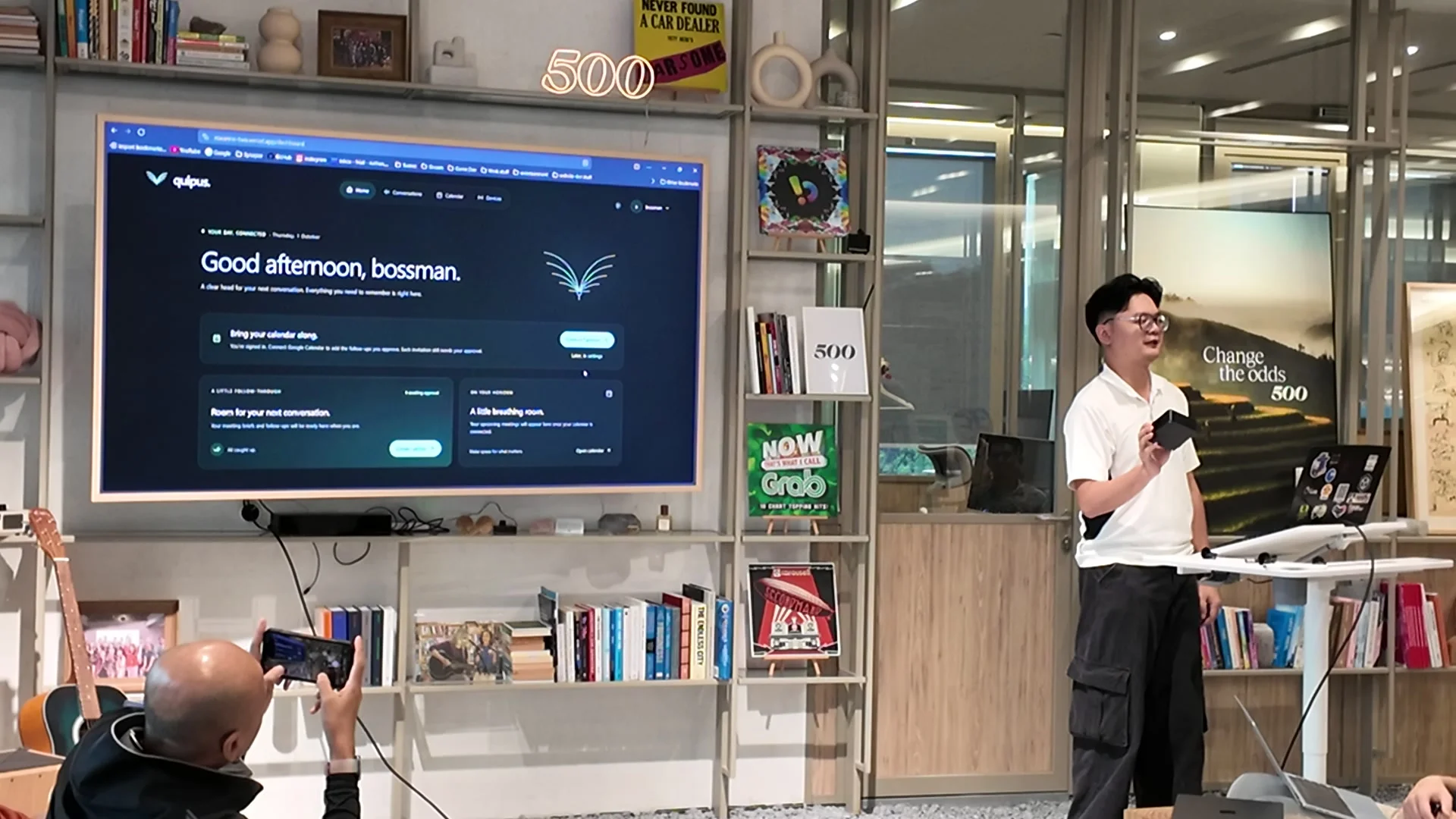
Nathan Hor built a handheld audio recorder paired with a web dashboard in three weeks for sales and business meetings. Earlier revisions relied on a phone hotspot and lacked battery status, causing units to die mid-day. The updated prototype connects directly to local Wi-Fi, includes an on-device battery indicator and SD card slot, and automatically sleeps when untouched to avoid heat buildup. Battery life reaches roughly four hours of continuous recording, or up to six hours when recording twice a day.
After uploading audio over Wi-Fi, the dashboard transcribes speech across roughly five languages (including English, Malay, Mandarin, and Cantonese, handling mid-sentence code-switching), generates summaries and action items, and drafts Google Calendar invites for user approval. Nathan used Claude 3.5 Sonnet to help lay out a custom PCB in KiCad. During Q&A, he noted the device is not yet ready for sale: shrinking the casing while moving from a single microphone to a multi-microphone array for full-room capture remains the main hardware trade-off.
Kong Khai Jien: Hands-Free Mac Voice Agent
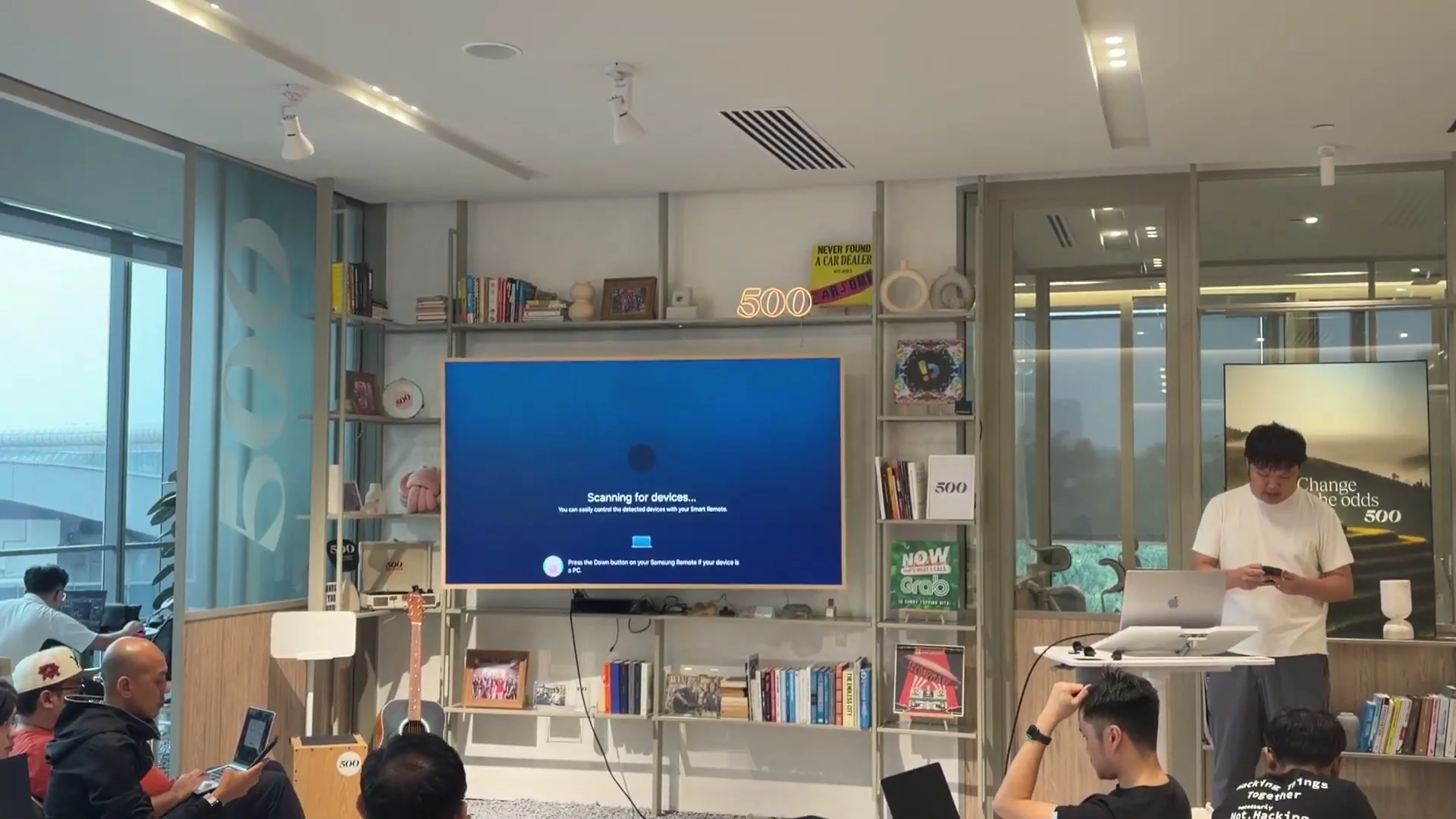
Kong Khai Jien demonstrated “Talk to the Agent on Your Own Mac,” a voice-controlled remote assistant meant for away-from-desk use such as jogging with earbuds. A mobile app sends spoken commands over the internet to a MacBook to run terminal commands, browser navigation, and system tasks. During the demo, he triggered his laptop over AirPlay to open Facebook.
Khai noted that making the synthetic voice more expressive improved interactivity. Because commercial tools like Claude and Codex already ship voice features, he is positioning the project around open-source model compatibility and deep Codex integration so the agent can launch and control applications across macOS rather than stalling on whichever window happens to be active. The demo also highlighted a practical live-presentation risk: automating a logged-in personal browser on a shared screen can expose private accounts, making isolated browser profiles essential.
Production Workflows: OCR, E-Commerce, and Shared Compute
Muhammad Hazwan Azman: OCR Pipelines, Rapid Prototyping, and Micro-Interactions
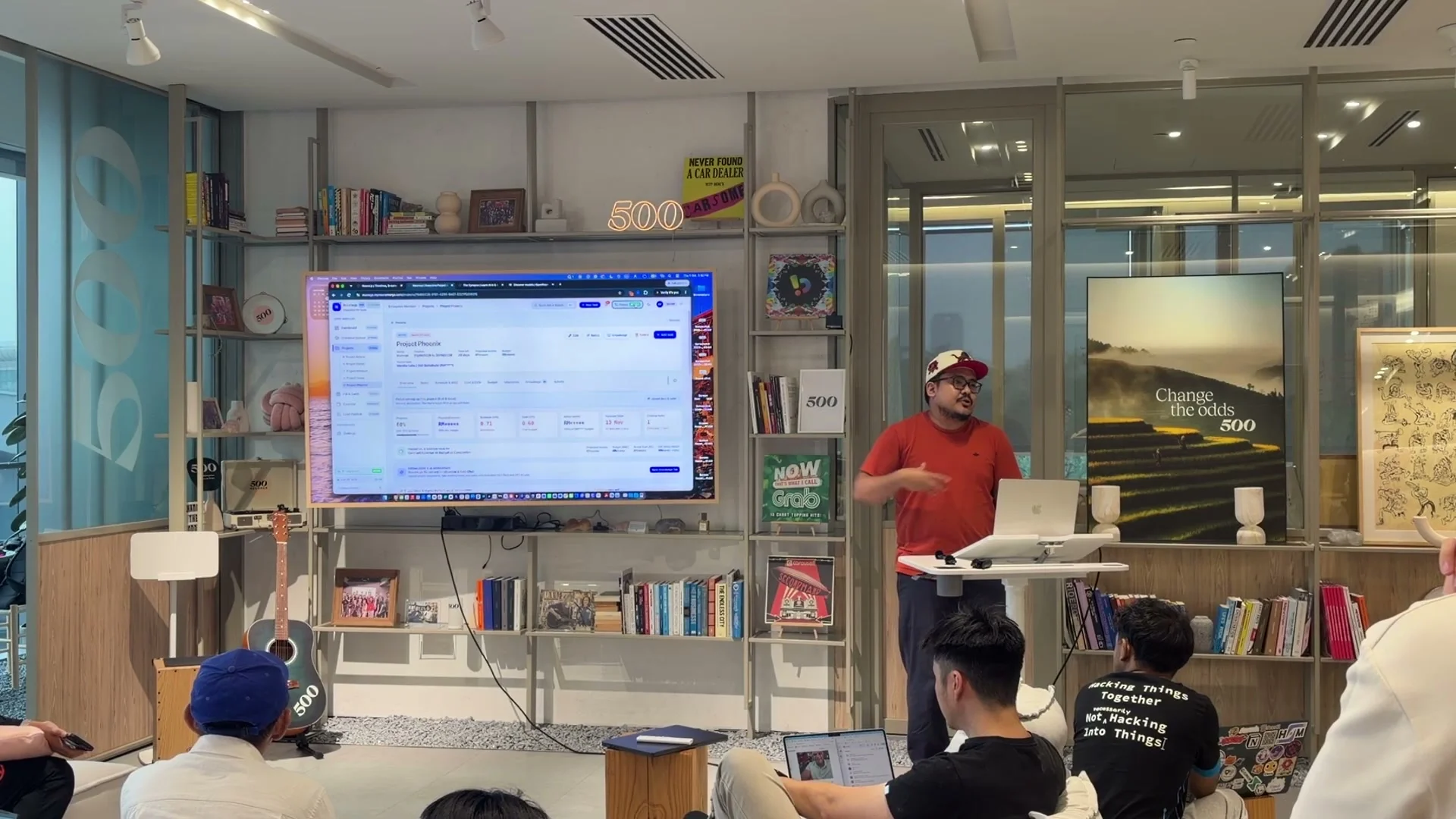
Muhammad Hazwan Azman shared what he learned shipping two production apps and five websites over five days using Claude Opus and Astra 6.1. His production OCR app processes receipts, invoices, and accounting records through a three-stage pipeline (detection, healing, and reviewing) labeled “Caught before the ledger.” Real-world documents regularly broke naive extraction with sideways photos, upside-down text, missing decimals, wrong years, ghost table rows, vendor stamps misread as merchant names, and local market shorthand, which he called the hardest failure mode to fix.
He also showed the Neumerge knowledge hub (assembled in about five minutes on top of an existing codebase) and NeuroUp, a project management app built as a simpler alternative to ClickUp and monday.com. Adding an interactive pre-signup simulator on the landing page lifted web traffic by 20%. On screen, he showed a toggleable privacy mode masking client names and Ringgit figures for live demos. His sharpest engineering warning came from UI polish: while utility features like privacy masking were quick to build, fixing visual jitter across five overlapping bounding boxes in an Apple-style scrolling card collapse failed in Gemini and burned 200 million tokens in Claude Opus.
Shahbaaz Siamwala: Leap Radar for Shopee Market Research
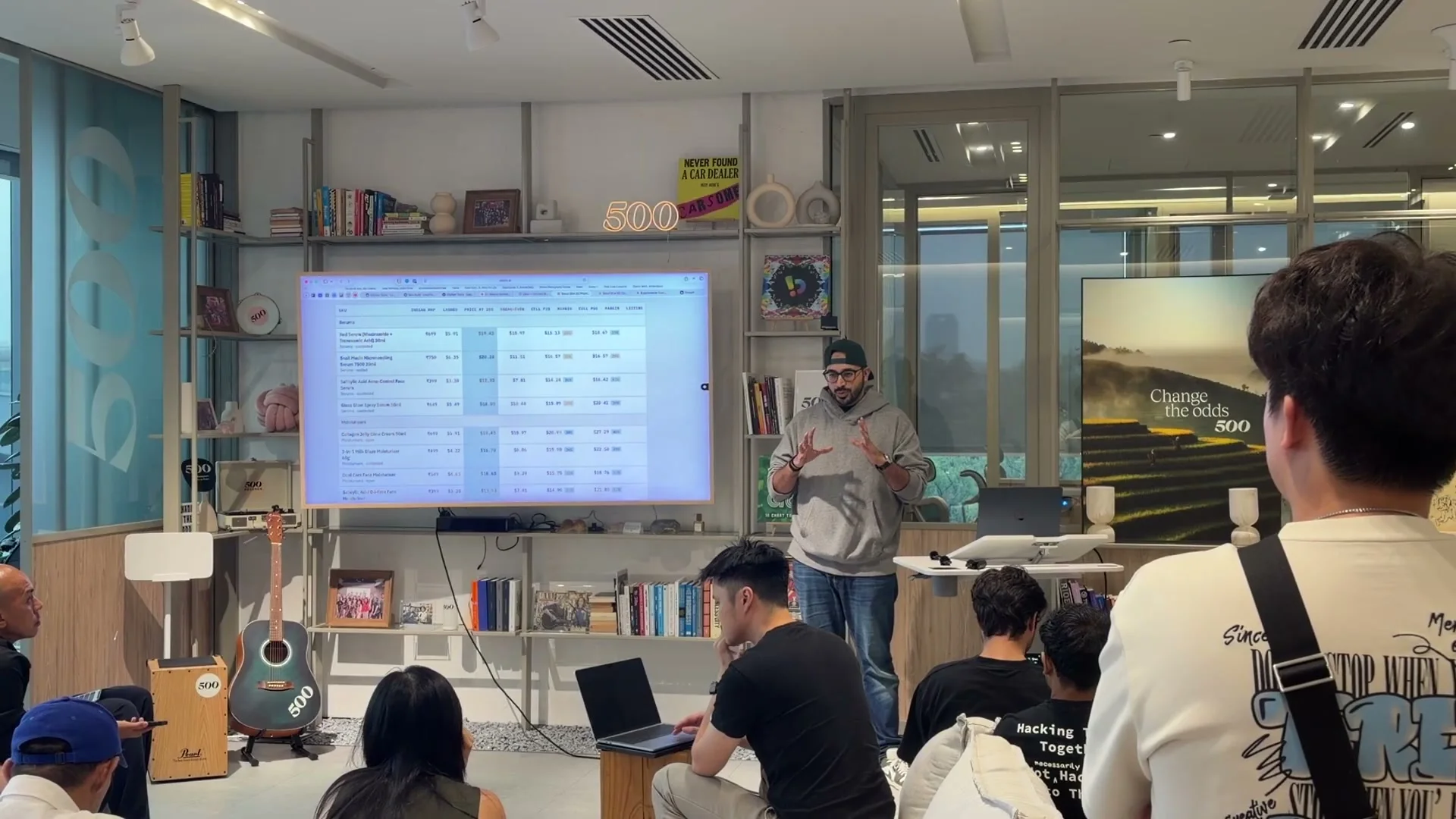
Shahbaaz Siamwala presented Leap Radar (leapradar.io), a market intelligence platform live for Shopee in Singapore and Malaysia, with Lazada and TikTok also in scope. Instead of relying on fragmented reports or Reddit threads, users enter a category or competitor and run an MCP connector workflow that scrapes 10,000 SKUs, product display pages, and customer reviews in 40 minutes.
He walked through an “SG Beauty Market Insights” report and an internal beauty brand feasibility spreadsheet modeled with Claude to target a 35% profit margin. In Q&A, Shahbaaz explained how Leap Radar estimates monthly revenue per SKU: it computes the average price across product variations (reflecting vouchers and discounts active at scrape time) and multiplies by the 30-day unit sales visible on Shopee’s front end, allowing sellers to audit every figure directly against live listings.
Andrew: ClosedRouter for Pooled AI Quotas
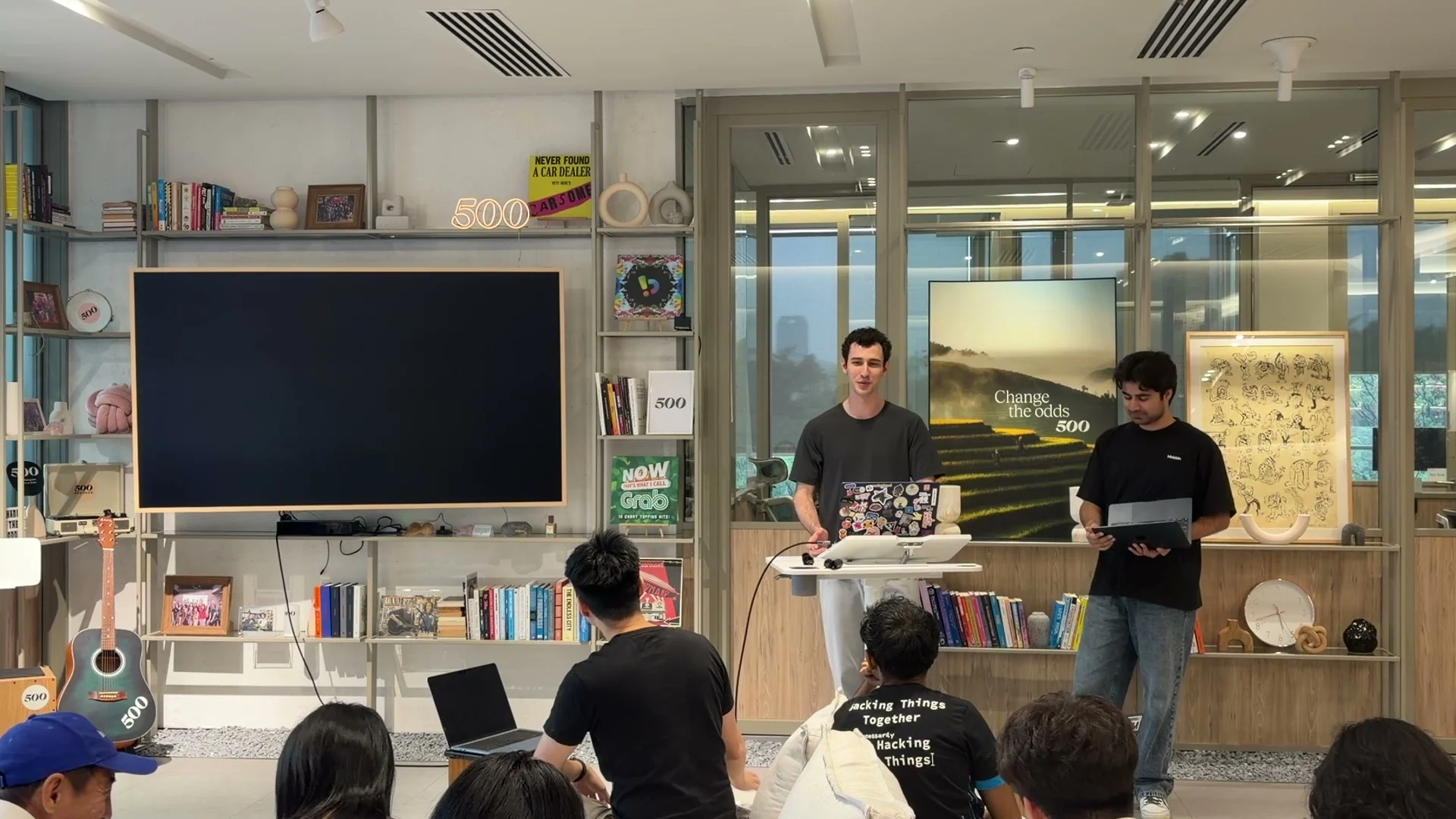
Andrew presented ClosedRouter, built for developer cohorts and residencies where members pay for high-tier AI subscriptions but leave large portions of their daily or monthly quotas unused. Participants contribute accounts and API keys (including Codex, Antigravity, and Cursor) with custom limits such as 500k tokens per day or 50% of a quota.
ClosedRouter exposes the pool through a standard OpenAI-compatible API endpoint so existing tools like Cursor CLI connect without custom wrappers. Any evaluation harness in the workspace can run against any contributed model, tracked in a central dashboard with Eval, Metrics, and Teams views.
Faris Irfan: Dossair Application Agent
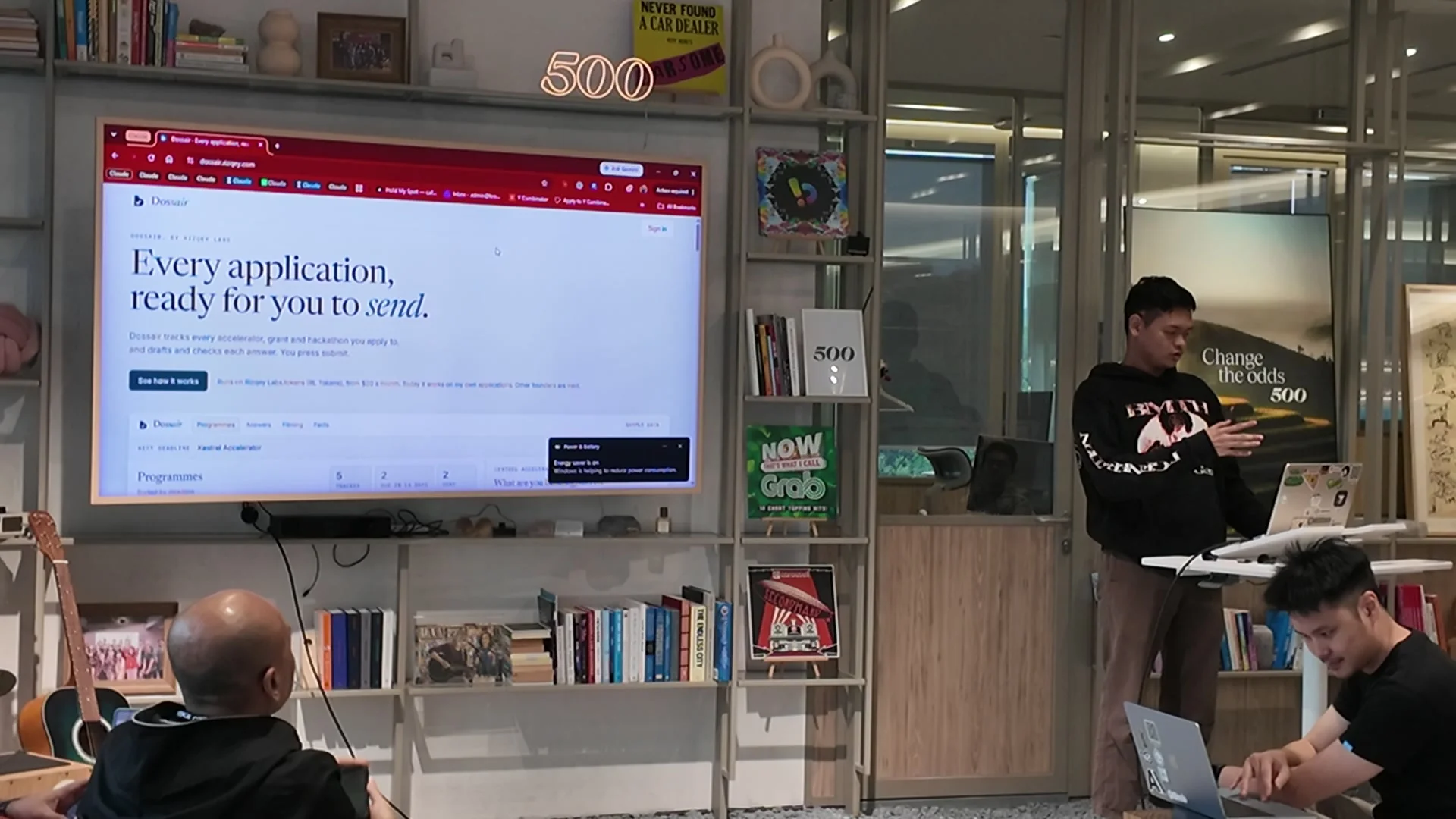
Faris Irfan of Rizqey Labs demoed the same-day alpha release of Dossair (dossair.rizqey.com), an agent that helps students and founders discover and apply to accelerators, grants, and hackathons. Prompted by an inquiry from an Indian university, Dossair ingests resumes, LinkedIn profiles, portfolios, and GitHub repositories, spends roughly 30 minutes matching programs such as Y Combinator S24, and pre-fills questionnaire fields via a Chrome extension for user approval.
Faris plans to move from the Chrome extension to a standalone virtual machine with its own browser and terminal. Because he is currently absorbing user token costs himself, he expanded from Claude to Groq, GroqCloud, and OpenRouter to keep token burn low, and embedded an in-app feedback chatbot on the lower left of the alpha page to catch bugs immediately.
3D Worlds for Heavy Industry and Malaysian Classrooms
Puviin Varman: 3D Industrial Models and Digital Twins
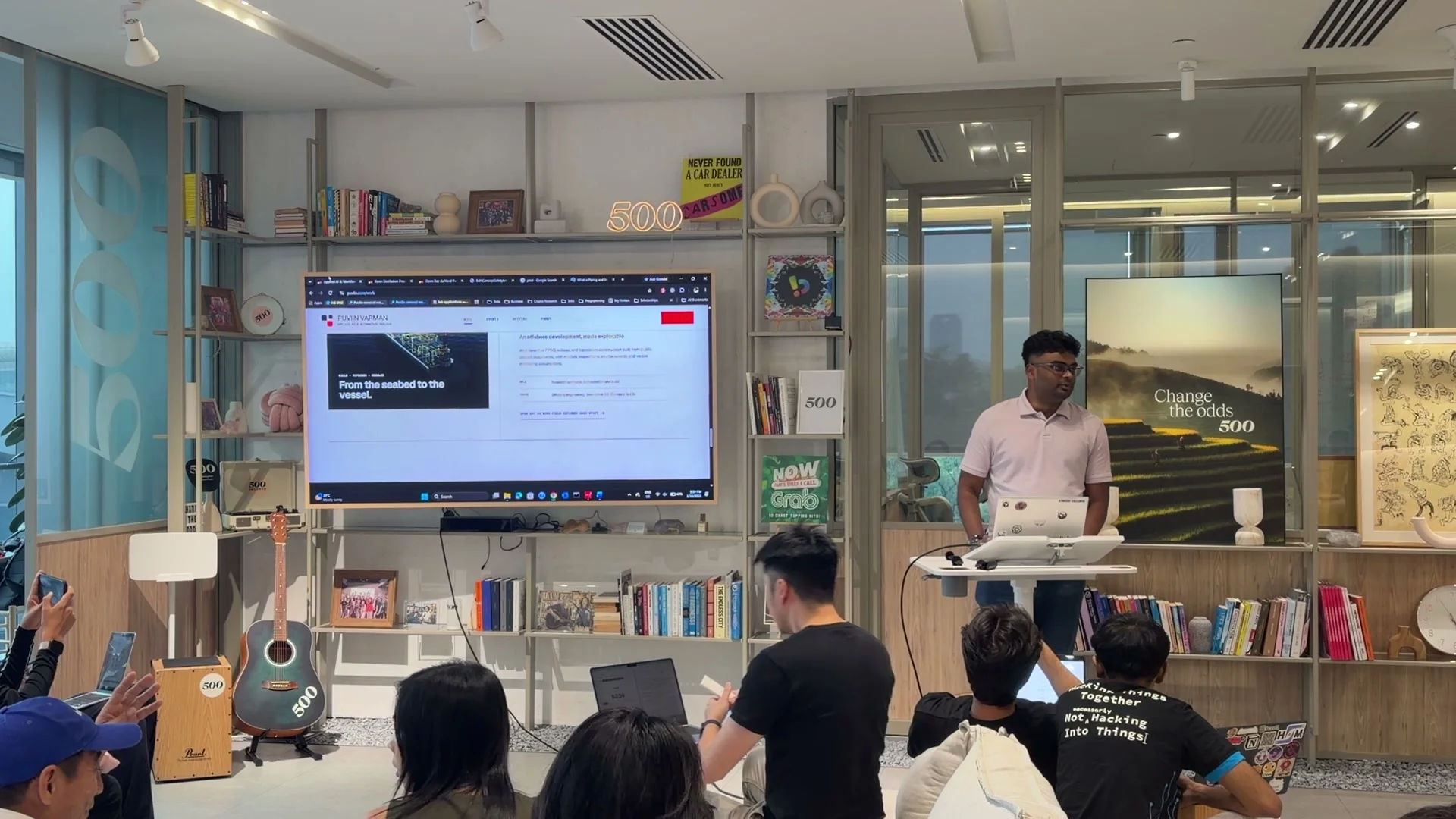
Puviin Varman presented four 3D workflows aimed at chemical, mechanical, and electrical engineers. Starting from 2D piping and instrumentation diagrams (P&IDs), he used Astra to reconstruct a 3D industrial process skid with inspectable motors, vessels, actuators, piping lines, and gratings. He also built a browser-based 3D digital model of an unbuilt FPSO vessel covering 12 topside crude treatment modules, subsea extraction points, and mooring lines in three days from Camcode process specs and P&IDs.
To verify modular assemblies before construction, he spent a week building a Three.js inspection yard where individual modules can be isolated to check pipe connection points and fix misaligned geometries. He also showed a simple multi-story structural frame generated by grounding an LLM prompt with engineering textbooks.
Chun Saw: Balance Boy 3D Math Prototype
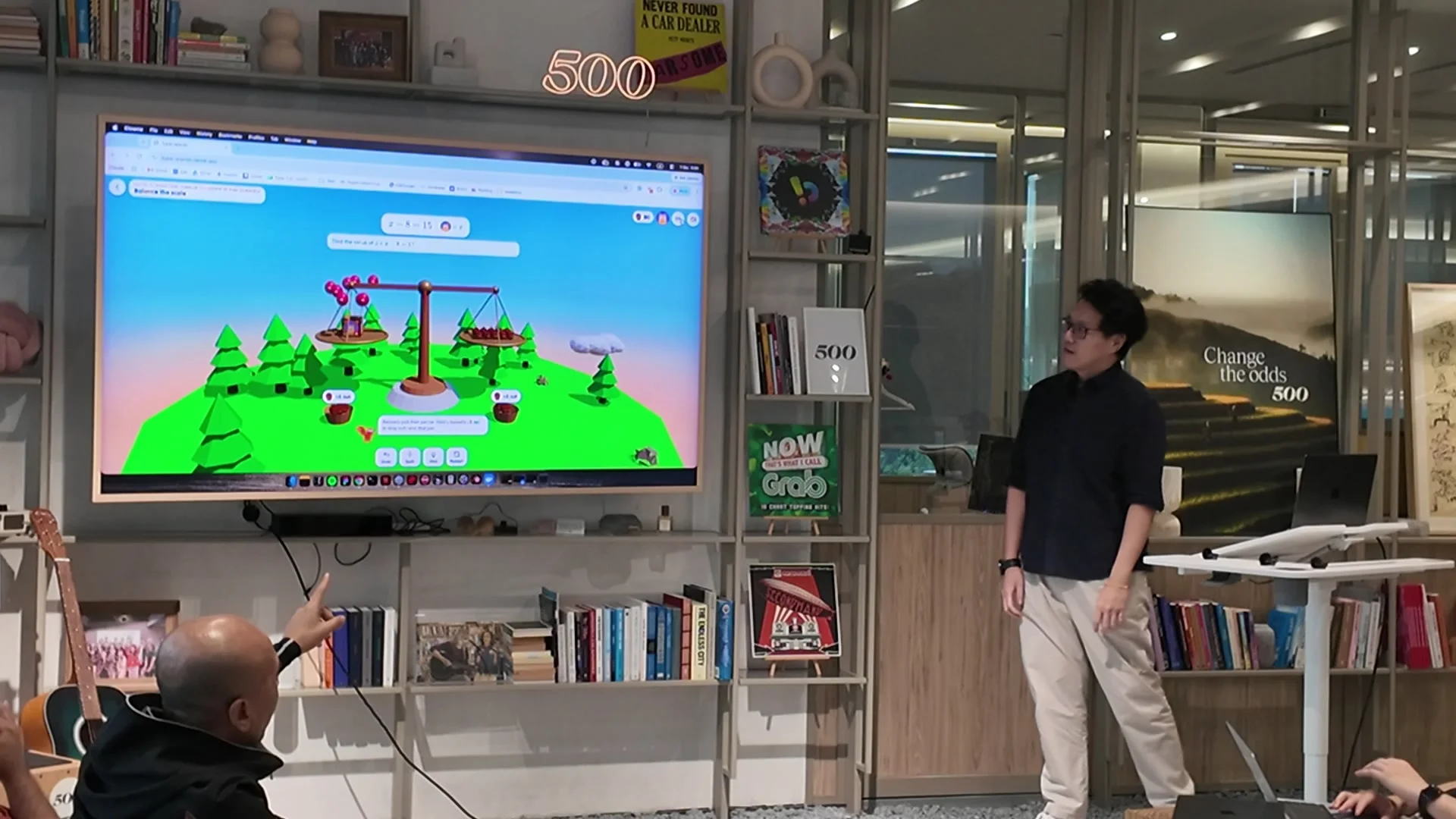
Chun Saw demonstrated Balance Boy (Match the Scale), a 3D web math prototype for Malaysian primary and secondary students, including SPM candidates and SJKC graduates transitioning into Malay-medium secondary school. Pulling curriculum questions from an internal database and Firebase, the app shifts struggling students from formal algebra equations like x - 8 = 15 onto an interactive 3D balance scale where balancing weights frees an in-game character.
Because students found text-only chatbots dry, Chun added on-demand voice narration switching between English, Malay, and Mandarin. He coded the prototype in raw Three.js using Tupai repository brand assets after testing showed Three.js rendered cleaner visuals than Astra, reaching the demoed quality in two iterations. When the 3D build loaded slowly on some phones, he built a lightweight 2D frog-path fallback overnight.
Consumer Apps, Animated Shorts, and Builder Programs
Richard Tan: PowPaw Pet Lifestyle App and Merchant Platform
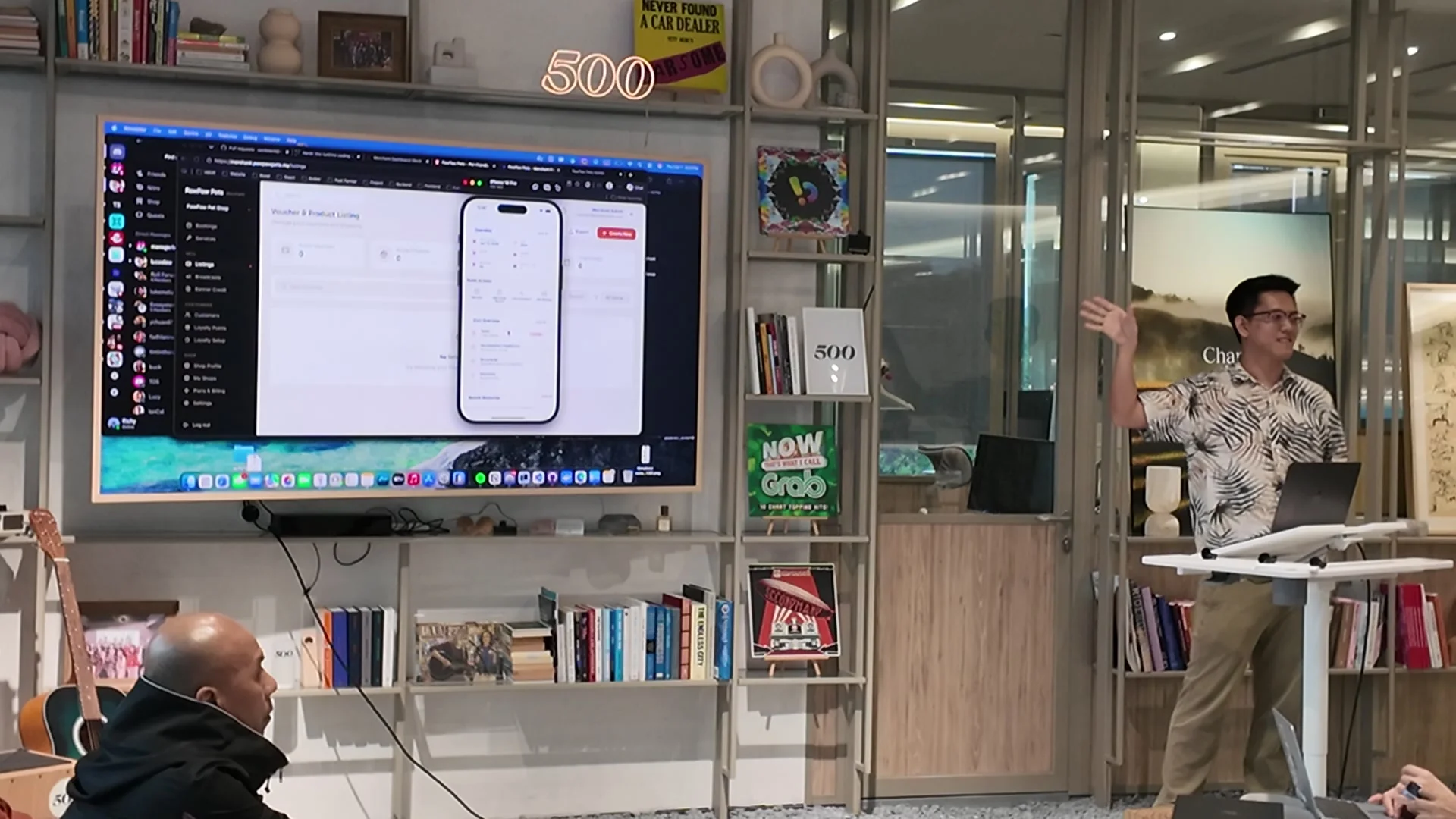
Richard Tan presented PowPaw Pet (branded on the web as PawPaw Bay), live on both Google Play and the iOS App Store. The consumer app is free and offers a directory of pet-friendly venues, flexible multi-pet profiles, a digital health passport for allergies and medical history, and free 7-day or 30-day push reminders for annual vaccinations.
On the B2B side, Richard demoed a merchant web dashboard covering bookings, services, opening hours, and product listings for veterinarians, groomers, and pet hotels. To build merchant confidence before charging subscriptions, the team is offering free pilot access to roughly 50 businesses. He also noted that moving from older AI UI tools to Opus 3.5 noticeably improved visual styling during the rebrand.
Chai: Rift Rider Animated Sci-Fi Short Film
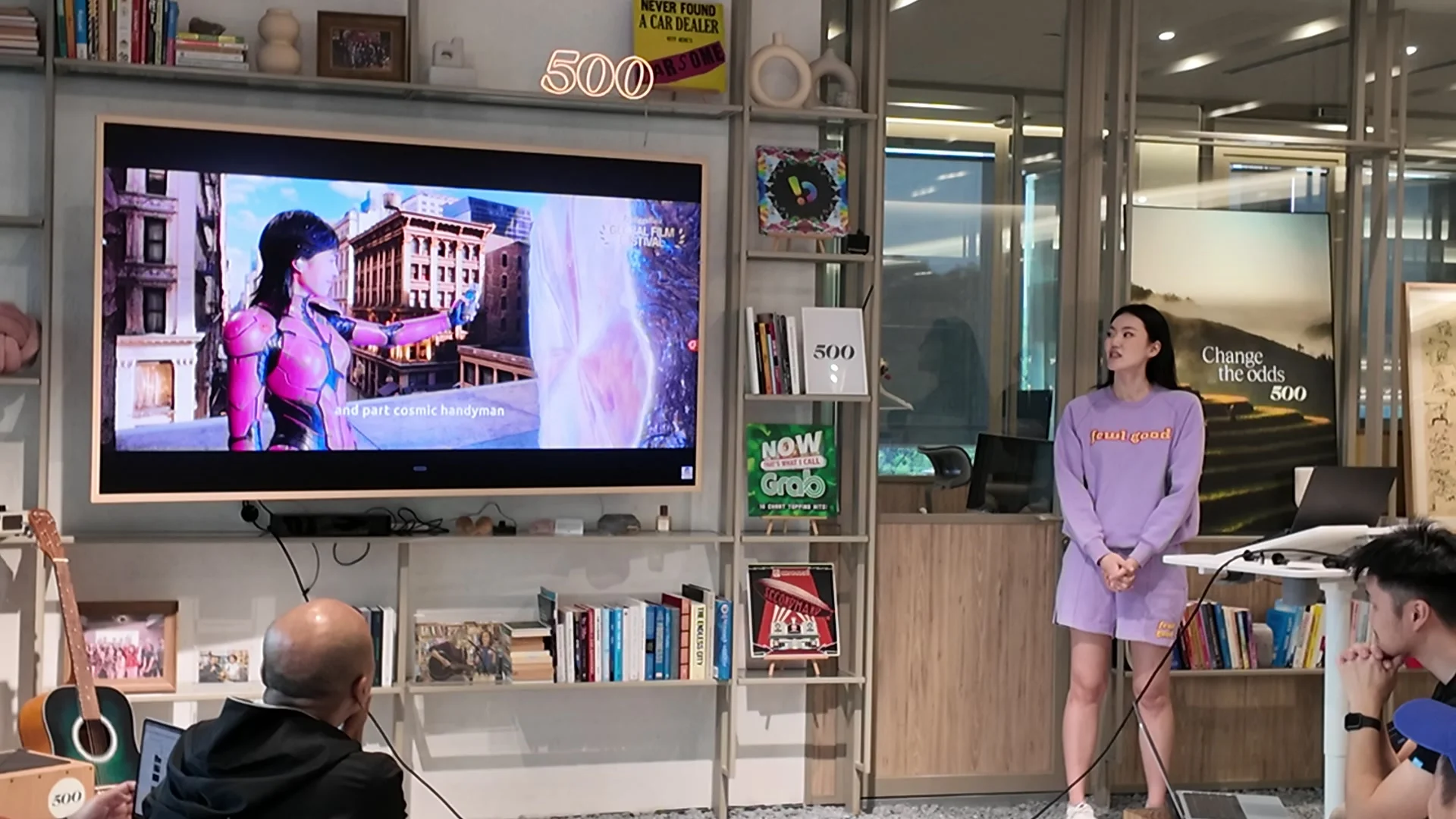
Chai screened excerpts from Rift Rider, her animated sci-fi short film on YouTube (channel handle Supamortal, spelled S-U-P-A-M-O-R-T-A-L). The story follows Acro, a cosmic handyman riding a hoverbike named Pegasus who runs an interdimensional delivery service featuring “Exotic alien snacks,” “Galactic spicy ramen,” and a “Musang King Quantum Grenade” to pay her bills before negotiating a 70/30 bounty split with Gungun to patch a black hole rupture at dimension 1305.
The film pairs Chinese rap background music with stylized dialogue and English subtitles, and carried a Global Film Festival 2024 laurel on screen. A surprise YouTube ad mid-screening gave the room a classic live-demo reminder: download video files locally before stepping on stage.
Marianne: Superteam Malaysia and Colosseum Hackathon
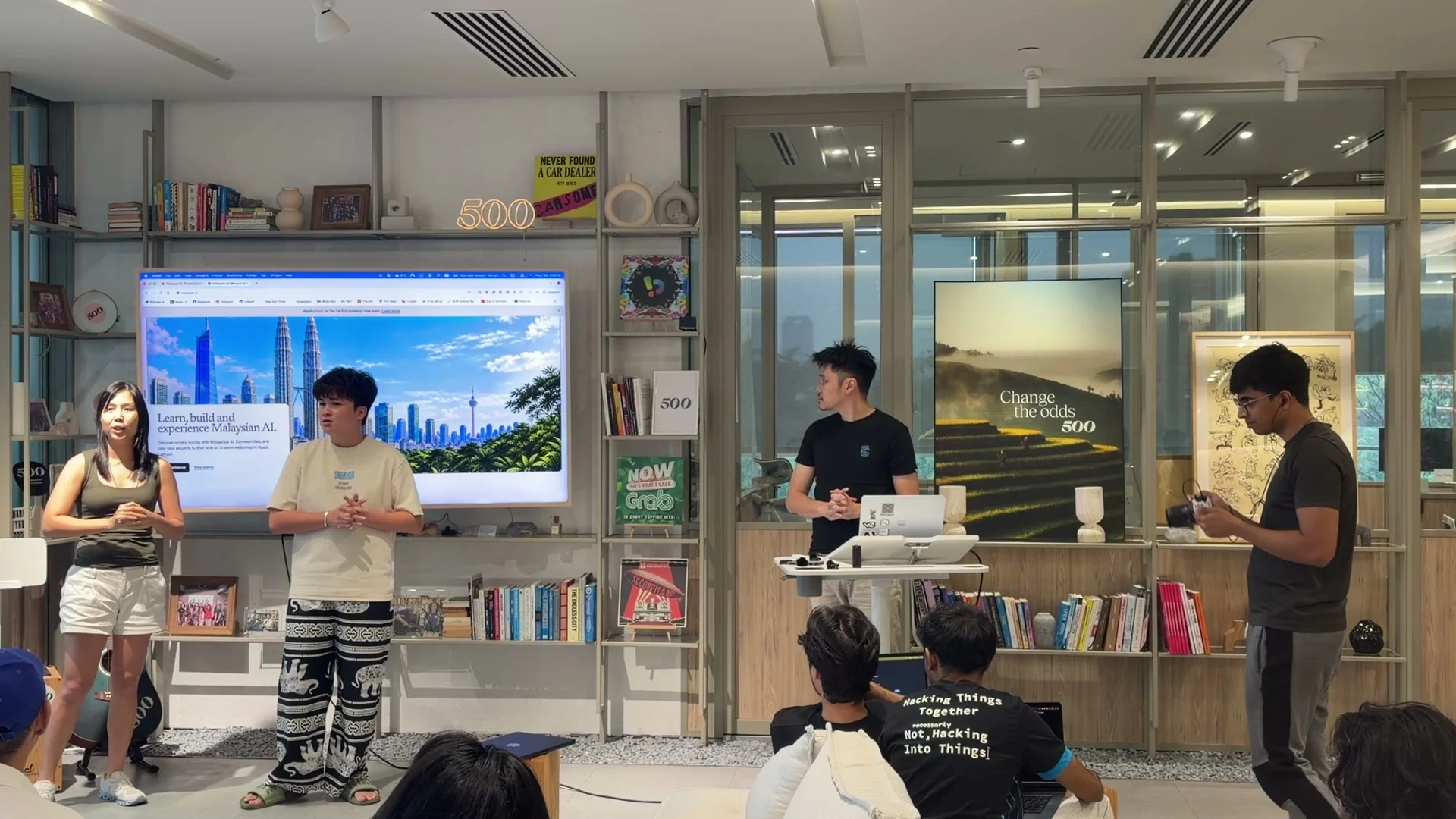
Marianne introduced Superteam Malaysia and the Colosseum global hackathon, running until October 12 with an $840,000 USD prize pool. At least 10 winning teams receive up to $250,000 USD in investment and entry into Colosseum’s San Francisco accelerator, with winners announced at Breakpoint. She encouraged AI builders to consider adding an on-chain component on Solana or any of seven other supported chains to compete for both global tracks and a $5,000 to $7,000 USD local Malaysia track.
Alexandre Claude Jeandel: 999 Venture Studio Model
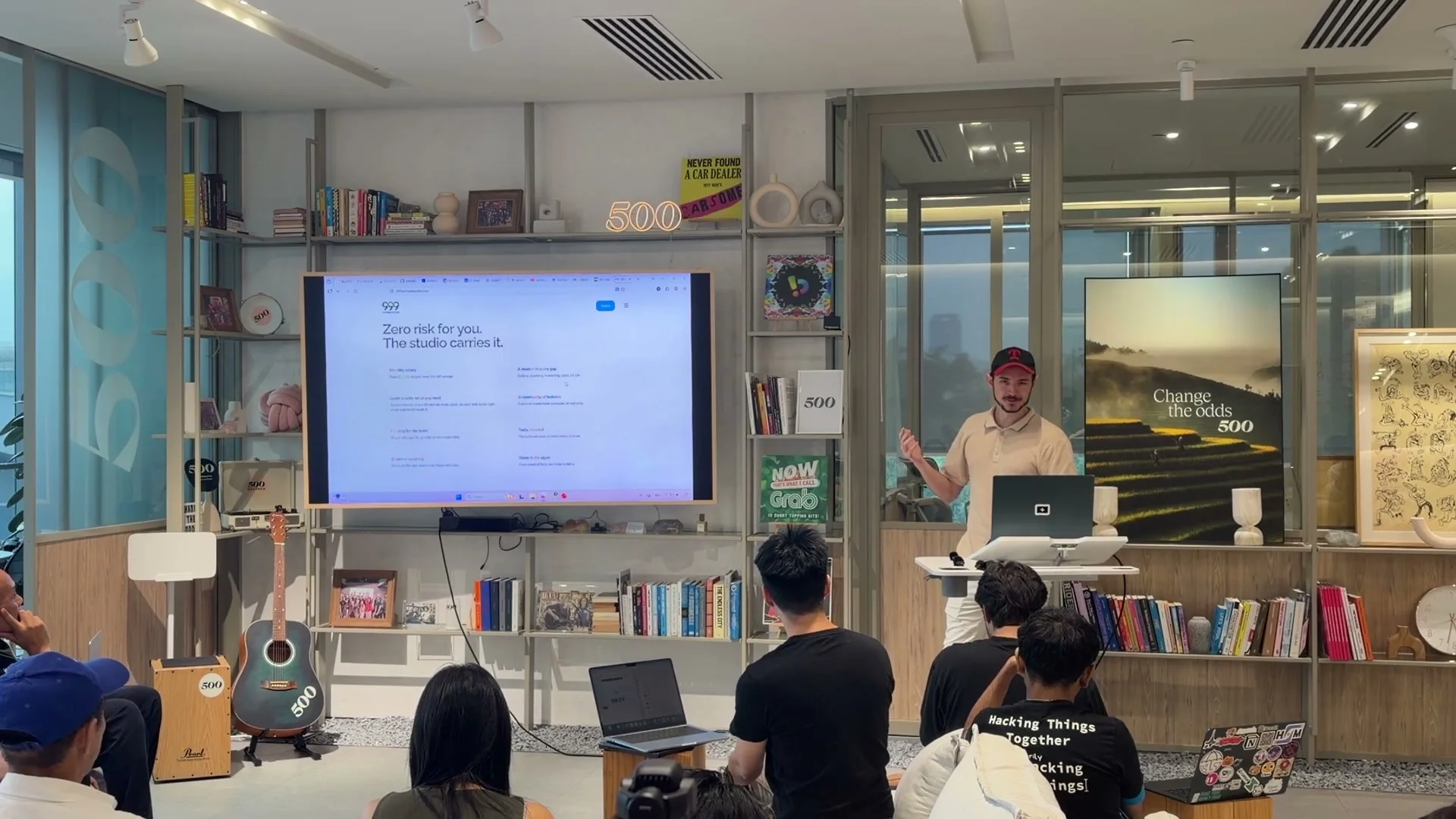
Alexandre Claude Jeandel walked through 999, a venture studio model aimed at builders who have already gone through multiple failed product launches. After an audience poll showed many attendees had experienced between one and ten failed launches, he outlined the studio’s pitch: instead of solo builders burning personal savings, the studio absorbs financial risk, pays a salary, and pairs builders with mentors.
Practical Lessons From the Room
- Plan for messy inputs in production: Hazwan’s OCR pipeline needed explicit detection, healing, and review stages plus fallback code for upside-down receipts, ghost rows, and local market shorthand.
- Ship lightweight fallbacks for constrained devices: Chun’s overnight 2D build solved mobile load-time bottlenecks that his Three.js 3D scene hit on lower-end phones.
- Watch where AI debugging tokens actually go: Standard business features and privacy toggles were cheap to build, while subtle CSS and bounding-box micro-animations burned 200 million tokens.
- Protect live demos from preventable friction: Keep local video copies to avoid YouTube ads (Chai), use isolated browser profiles or privacy toggles so real client or personal data never hits the projector (Khai and Hazwan), and pre-compute long agent research runs before going on stage (Faris).
Featured speakers & demos
20 builders demoed during this session. Browse full talk notes and Q&A in the Knowledge Base
Rift Rider Animated Sci-Fi Short Film
Chai screened excerpts from her animated sci-fi short film Rift Rider on YouTube (Supamortal), blending multiverse delivery worldbuilding with Malaysian references like a Musang King Quantum Grenade.
Hands-Free Voice Agent for Mac Automation
Kong Khai Jien demonstrated a mobile-to-Mac voice agent that lets users run browser and system commands remotely through earbuds using open-source models and Codex.
Recorded presentation
Visual analysis could not be completed for recording 0.000–11.250 seconds. The audio transcript is preserved for admin review; speaker attribution and knowledge claims remain unverified. Visual analysis could not be completed for recording 11.250–22.500 seconds. The audio transcript is preserved for admin review; speaker attribution and knowledge claims remain unverified. Visual analysis could not be completed for recording 22.500–33.750 seconds. The audio transcript is preserved for admin review; speaker attribution and knowledge claims remain unverified. Visual analysis could not be completed for recording 33.750–45.000 seconds. The audio transcript is preserved for admin review; speaker attribution and knowledge claims remain unverified. Visual analysis could not be completed for recording 45.000–56.250 seconds. The audio transcript is preserved for admin review; speaker attribution and knowledge claims remain unverified. Visual analysis could not be completed for recording 56.
Hands-free voice control for a computer
The presenter demonstrates a voice-control app for operating a computer hands-free, including a phone-to-computer workflow and an example that opens Facebook. The presenter describes a more interactive, emotional voice and considers open-source connectivity, export, and compatibility as possible differentiators, while expressing uncertainty because Codex and cloud apps also support voice interaction. An audience member suggests a microphone-equipped remote; the presenter says they use another remote with their phone but do not carry it while jogging.
ClosedRouter: Shared AI Subscription Token Pooling
Andrew presented ClosedRouter, a platform that pools unused AI subscription quotas and API keys across developer residencies behind an OpenAI-compatible endpoint with shared evals.
3D Industrial Models and Digital Twins
Puviin Varman showed 3D industrial process skids reconstructed from 2D P&IDs, a browser digital twin of an unbuilt FPSO vessel, a Three.js module yard inspector, and textbook-grounded structural modeling.
OCR production app
The presenter describes an OCR production app and reports making two production apps and five full websites over about five days using “OPUS Astra 6.1.” The app’s name and implementation details are not established. The talk covers OCR edge cases, fallback code, and the difficulty of handling market shorthand.
OCR production app and edge cases
The presenter describes an OCR production app and discusses the edge cases it handles. The app’s identity, audience, and further behavior are not established in the footage. The presenter also reports building two production apps and about five websites in five days, attributing the pace to Opus Astra 6.1.
OCR Pipelines, Rapid Apps, and UI Polish
Muhammad Hazwan Azman covered shipping two production apps and five websites in five days, detailing a three-stage receipt OCR pipeline, the Neumerge knowledge hub, and NeuroUp with privacy masking.
Rift Rider Short Film Screening and Q&A
Chai introduces and screens excerpts from her animated sci-fi short film titled 'Rift Rider' via YouTube. The narrative centers on Acro, a dimension-jumping cosmic handyman operating a flying vehicle named Pegasus and running an interdimensional delivery service to pay bills. Following a brief commercial interruption during playback, Chai explains elements of the story and worldbuilding, including Malaysian cultural references, before concluding with an audience Q&A where she shares her YouTube channel handle.
PowPaw Pet Lifestyle App and Merchant Platform
Richard Tan demoed PowPaw Pet (PawPaw Bay), a live iOS and Android pet lifestyle app with vaccination reminders and a merchant dashboard onboarding 50 pilot businesses.
Superteam Malaysia and Colosseum Hackathon
Marianne introduced the Superteam Malaysia and Colosseum global hackathon, highlighting an $840,000 USD prize pool, San Francisco accelerator spots, and a local Malaysia track.
Recorded presentation
Shabaz introduces himself as an e-commerce person. The screen initially shows a “Check Device Power” prompt; later it displays a title slide reading “KNOW WHAT SELLS BEFORE YOU SELL IT.” No project demonstration or substantive explanation is heard in this excerpt.
Balance Boy 3D Educational Math Game
Chun Saw built Balance Boy in raw Three.js to teach algebra to Malaysian students through an interactive 3D balance scale with English, Malay, and Mandarin voice narration, plus a 2D mobile fallback.
Leap Radar: Shopee Market Intelligence
Shahbaaz Siamwala demoed Leap Radar (leapradar.io), scraping 10,000 Shopee SKUs and reviews in 40 minutes to estimate demand and model launch pricing for Southeast Asian sellers.
Marketplace product-launch research tool
The presenter describes a recently launched SaaS tool for researching products across Southeast Asian marketplaces. Users enter a category or competitors and the tool gathers market insights from Shopee for a selected country. The demonstration uses Shopee Singapore’s beauty market and discusses product, seller, category, and estimated-revenue analysis to inform launch decisions. The presenter also mentions an MCP connector, but its purpose is not fully explained. The interface’s fine text is not legible in the supplied frames.
Shopee market-research SaaS for product launches
Shabaz presents a SaaS tool for researching products before launch, following the team’s earlier research-as-a-service work. He describes the tool as addressing fragmented market research by searching Shopee in a selected country based on category or competitor details. The demonstration focuses on beauty in Singapore and shows market insights and product data. He says the research can cover 10,000 SKUs in 40 minutes, including reviews and product display pages. He describes revenue figures as estimates based on Shopee’s front end and says data is pulled in real time and can be checked against Shopee’s website. He connects category and competitor information to decisions about product variants, launch pricing, and profitability. The excerpt ends before he explains the mentioned MCP connector.
Conversational AI Hardware Recorder and Dashboard
Nathan Hor demonstrated a handheld Wi-Fi audio recorder and web dashboard that transcribes multilingual meetings, extracts action items, and drafts Google Calendar invites.
999 Venture Studio Model for Builders
Alexandre Claude Jeandel presented 999, a venture studio model offering salaries, mentorship, and studio-absorbed financial risk to builders who have experienced prior product launch failures.
Dossair: Accelerator and Hackathon Application Agent
Faris Irfan launched the alpha of Dossair (dossair.rizqey.com), an AI agent that matches founders to programs, pre-fills forms via a Chrome extension, and routes across Groq and OpenRouter to lower token costs.